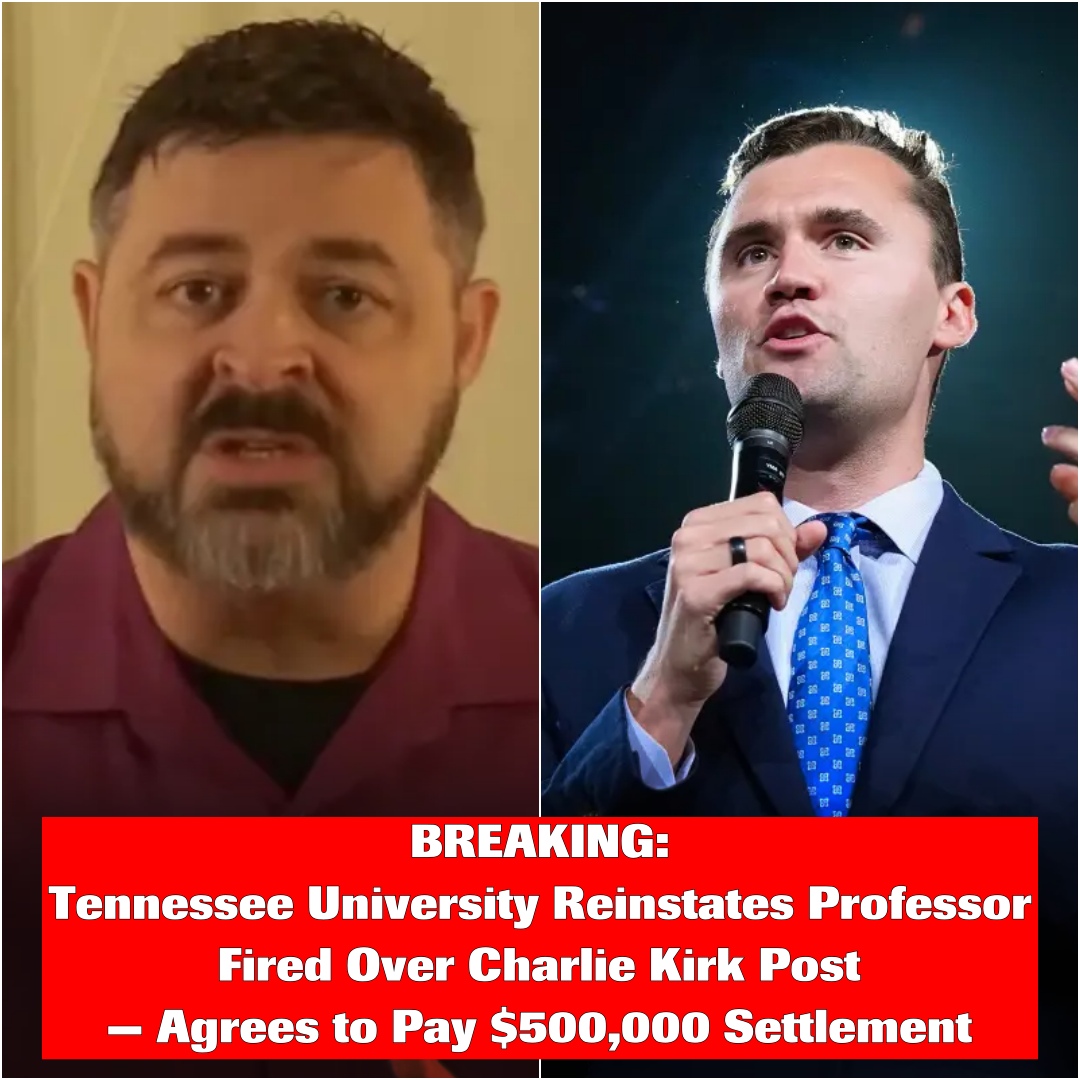
A Tennessee professor is back in the classroom — and $500,000 richer — after a public university fired him over a social media post in the chaotic aftermath of conservative activist Charlie Kirk’s assassination, only to reverse course months later in a stunning settlement.
Darren Michael, an associate professor of acting and directing at Austin Peay State University (APSU), has been reinstated following his abrupt termination last year — and the university has reportedly agreed to pay him half a million dollars as part of a settlement tied to his dismissal, according to documents obtained by local outlet WKRN News 2.
And the payout doesn’t stop there.
The school also agreed to reimburse Michael for “therapeutic counseling services,” signaling the case was never just about a single Facebook post — but about what happens when public outrage collides with employment law, tenure protections, and political pressure.
It’s the latest flashpoint in America’s intensifying cultural war: free speech vs. decency, campus politics vs. public backlash, and whether universities can act like corporations when controversy explodes — then quietly pay the price later.
How It Started: A Post After a Political K!lling… and a Shock Firing
Michael was fired on September 12 — just two days after Kirk was reportedly shot and k!lled by a sniper at Utah Valley University — after university leaders said the professor’s social media behavior was “insensitive” in the wake of the national tragedy.
According to the outline of the case, one Facebook post in particular became the lightning rod:
Michael shared an article titled:
“Charlie Kirk says g::un d3aths are ‘unfortunately’ worth it to keep 2nd Amendment.”
He did not add a caption, explanation, or commentary — but the timing alone, critics argued, was unmistakable.
Within hours, the post gained political traction far beyond campus.
U.S. Senator Marsha Blackburn (R–Tennessee) reportedly amplified the controversy on social media, sharing a screenshot of Michael’s Facebook post and posting a blunt question aimed at APSU:
“What do you say, Austin Peay?”
Her post reportedly included a photo of Michael and his resume — putting a professor’s identity into the center of a nationwide political storm.
And that was the moment the situation stopped being a campus disciplinary issue…
and became a public spectacle.

The University’s Statement: ‘Unacceptable’ and ‘Disrespectful’
Later that same day, APSU issued a statement indicating that Michael had been terminated because his social media comments were seen as:
“insensitive, disrespectful and interpreted by many as propagating justification for unlawful d3ath.”
The statement attributed to APSU President Mike Licari framed the firing as a moral decision — a line drawn for “human dignity.”
“Such actions do not align with Austin Peay’s commitment to mutual respect and human dignity,” Licari reportedly said.
“The university deems these actions unacceptable and has terminated the faculty member.”
To many readers, it sounded decisive — even righteous.
But behind the scenes, according to the settlement terms now coming to light, the university may have made one critical mistake:
They allegedly didn’t follow the tenure termination process.
And that single procedural failure can turn a “strong public statement” into an expensive legal disaster.
The Reversal: Reinstated… and Paid
Now comes the jaw-dropping twist.
Michael has reportedly been reinstated — meaning the university not only reversed the firing, but returned him to his job after months of controversy.
And in the settlement, APSU agreed to pay:
 $500,000 reimbursement for therapeutic counseling and issue a formal regret statement acknowledging the school did not properly follow the tenure termination process
One line in the agreement, reportedly obtained by WKRN, cuts right to the heart of the humiliation:
“APSU agrees to issue a statement acknowledging regret for not following the tenure termination process…”
Even more striking is how the statement will be distributed:
“The statement will be distributed via email through APSU’s reasonable communication channels to faculty, staff, and students.”
In other words: not buried quietly.
Not sealed in a file cabinet.
But sent out through the university’s internal system — a public admission, at least to the campus community, that the process failed.
And that failure now has a price tag.


Why This Settlement Is Bigger Than One Professor
This isn’t just about Darren Michael.
This is about a pattern that plays out again and again in American institutions:
-
A high-profile tragedy happens
-
Public emotion spikes
-
A controversial post goes viral
-
A politician amplifies it
-
The institution panics
-
A rapid termination occurs
-
The lawyers arrive
-
The institution pays — quietly, later
The emotional pressure is immediate. The legal consequences come afterward.
And the settlement amount here — half a million dollars — is exactly the kind of number that makes taxpayers and parents furious.
Because APSU is a public university.
Which means people will now ask:
Was this about values… or about avoiding political heat?
And if it was about values — why did those values collapse the moment the legal process came into focus?
The Key Issue: Tenure and Due Process
Tenure isn’t just a symbol. It’s a legal framework.
It exists precisely to prevent universities from firing faculty members based on momentary political pressure, online outrage, or public controversy.
When a professor has tenure, termination typically requires:
-
documented grounds
-
formal procedures
-
hearings or review processes
-
and adherence to contractual and institutional policies
The settlement language — “regret for not following the tenure termination process” — suggests the university acted too quickly.
And when an institution skips its own process, it doesn’t matter what the outrage cycle demanded.
In court, process is everything.
The Public Reaction: Two Americas, One Campus
This story is guaranteed to trigger outrage from both sides — because it hits the most combustible nerve in modern America:
For conservatives
This looks like a professor allegedly posting something that felt like mockery or justification after an assassination — then walking away with a $500,000 reward.
To many, that feels like moral insanity.
For civil-liberties advocates
This looks like a university firing someone in a politically overheated moment, then being forced to admit it broke its own rules.
To many, that feels like institutional cowardice.
And right in the middle is the reality that universities now live in:
One social media post can turn a professor into a national target in hours.
What This Means for Universities Now
If this settlement holds, it sends a loud message to every campus leader in America:
You can issue as many press statements as you want.
You can fire someone to satisfy outrage.
You can declare moral commitments.
But if you don’t follow your own rules — especially in tenure cases — you may be forced to:
-
reinstate the person
-
pay a massive settlement
-
and admit publicly that you mishandled the process
And the bigger question becomes:
Who actually wins in that outcome?
Because one side sees a professor getting paid for “insensitivity.”
The other sees a university trying to silence speech and losing.
Meanwhile, the institution burns credibility from both directions.
The Bottom Line
Austin Peay State University is now facing a harsh reality:
A firing meant to demonstrate “respect and human dignity” has turned into a settlement worth $500,000, counseling reimbursements, and an internal apology acknowledging procedural failure.
Darren Michael is back on the job.
But the university — and the public — will be left with the same uncomfortable question:
Was this ever about justice… or was it about panic?
And when institutions start firing first and doing due process later…
someone always ends up paying.
In this case?
It wasn’t the university president.
It wasn’t the senator.
It wasn’t social media.
It was a public institution.
And a half-million-dollar check.