My name is Rebecca Hayes.
The moment that still burns in my chest did not happen in a war zone or inside a classified operations room sealed behind layers of clearance and silence. It happened on a bright spring morning at my own father’s retirement ceremony—beneath polished chandeliers, crisp white uniforms, and a banner that read HONOR. LEGACY. SERVICE.
I arrived early, the way I always did. Old habits die hard in the Navy. The air outside the naval base in Virginia Beach was sharp enough to sting my lungs, carrying the smell of salt from the ocean mixed with fresh-cut grass and metal polish. Families gathered near the entrance, laughter drifting between them as children tugged at uniform sleeves and wives adjusted medals with careful hands.
I stood apart.
In my hand was an invitation folded neatly down the center. The paper was thinner than most, slightly worn from being opened and closed more times than necessary. My father’s name was printed in bold at the top, a name that had always carried weight in this place.
Captain Daniel Hayes.
Forty-two years of service.
Retirement Ceremony.
I read it one last time before stepping forward.
At the security gate, a young guard greeted me with a professional smile. He scanned my ID, then turned to the tablet mounted beside him. His fingers moved quickly as names scrolled past. Then his expression shifted—only slightly, but enough for me to notice.
He looked again.
Then once more.
“I’m sorry, ma’am,” he said carefully, angling the screen toward me. “Your name isn’t on the list.”
I leaned closer, already knowing what I would see.
Nothing.
Rebecca Hayes was not there.
The silence between us stretched, awkward and heavy. The guard’s face softened, as if he expected tears, anger, or confusion. I gave him none of those things. Years ago, I learned that certain wounds bleed inward.
“It’s fine,” I said quietly.
Out of the corner of my eye, I saw my father a few yards away. He stood among fellow officers, his posture straight, his laugh easy. The kind of man who filled rooms without effort. His eyes flicked toward me for a heartbeat—long enough to recognize me.
Then they slid away.
No surprise.
No denial.
Just dismissal.
As if I were a stranger waiting for a bus.
Through the glass doors of the ceremony hall, I saw my brother Michael in his immaculate white uniform. Cameras flashed as he shook hands with admirals and commanders. His smile was flawless, polished by years of knowing exactly where he belonged. Applause rippled through the crowd at his presence, effortless and automatic.
The Hayes legacy.
For a moment, an old ache tightened in my chest—the familiar one. The feeling that had followed me since childhood. The quiet knowledge that no matter how hard I worked, no matter what I achieved, I would always be the wrong kind of success in this family.
I turned and walked back toward the parking lot.
Each step was steady. Measured. I wasn’t retreating. I was retrieving something.
When I opened the trunk of my car, the garment bag waited there, untouched. I unzipped it slowly. Inside lay my dress whites, folded with precision. Beneath them, wrapped carefully in cloth, were three silver stars.
No one inside that hall knew.
Not my father.
Not my brother.
Not the guests applauding a story that had quietly erased me.
What they had removed from a guest list was nothing compared to what they had never bothered to ask about.
As I stood there, the past came rushing back—not in fragments, but as a whole.
I hadn’t always known I was invisible.
As a child, you assume silence means safety. You assume being easy, quiet, self-sufficient is a virtue. In the Hayes household, it was praised.
“Rebecca doesn’t need much,” my mother used to say with a gentle smile. “She’s independent.”
Independent was another word for unattended.
Michael, on the other hand, filled every room with sound. His laughter, his footsteps, his voice dominated dinner conversations. Coaches praised his leadership. Teachers called home about his potential. My father listened when Michael spoke.
When I spoke, he nodded.
At family gatherings, uncles clapped Michael on the back and joked about his future command. I sat on the couch with a book, absorbing patterns, numbers, strategies—things that stayed where you put them and didn’t vanish when ignored.
Once, when I was twelve, a neighbor asked my father what I wanted to be when I grew up.
Before I could answer, he laughed.
“Oh, she’s the smart one,” he said. “Michael’s the warrior.”
Everyone laughed.
I laughed too.
I learned early that if you don’t laugh, you become a problem.
By the time Michael received his acceptance letter to the Naval Academy, the future felt sealed in stone. Flags appeared on our lawn. Neighbors came over with beer and congratulations. My father hosted a barbecue that turned into a celebration of destiny.
That same month, I placed first in a national cryptography competition.
My father skimmed the letter.
“That’s nice,” he said. “But it’s not Annapolis.”
That was the moment I stopped asking for permission.
I joined the Navy quietly. No banners. No speeches. I chose intelligence—not the part of the military that marched in parades, but the part that worked in silence. Rooms without windows. Screens glowing in the dark. Conversations spoken in fragments and codes.
For the first time, my mind mattered more than my last name.
Iron Shield came three years into my service. A cyberattack designed to blind a carrier strike group mid-deployment. We had minutes. Maybe less. I rerouted systems manually, rebuilt data chains under pressure, and kept five thousand sailors from drifting blind into hostile waters.
No headline followed.
Then Silent Echo. A SEAL team trapped behind enemy lines, communications jammed, extraction window closing. I rerouted a satellite from another theater, broke protocol, and bought them the coverage they needed to escape.
Weeks later, a sealed envelope arrived.
Inside was a handwritten note.
We’re alive because of you.
I folded it carefully and placed it in my drawer.
No one in my family knew.
And standing in that parking lot, holding the uniform they never imagined I’d earn, I finally understood something with perfect clarity.
They hadn’t erased me because I failed.
They erased me because I no longer fit the story they wanted to tell.
I zipped the garment bag shut.
Took a breath.
And stepped back toward the hall.
I did not tell my family when I joined Naval Intelligence.
Not because it was classified—though much of it would become that—but because I had already learned something essential: the less I explained myself to them, the less power they had to redefine me.
My mother cried a little when I left. My father shook my hand like I was a distant relative embarking on a long business trip. Michael clapped me on the shoulder and said, “Good luck with the paperwork side of things.”
None of them asked what Naval Intelligence actually did.
I didn’t volunteer the answer.
The building I was assigned to had no sign outside. No windows either. You entered through a corridor that smelled faintly of recycled air and coffee that had been reheated too many times. Phones were surrendered at the door. Names were replaced by clearance levels. The first thing they taught us was that the most dangerous work often happened far away from applause.
I thrived there.
Not because it was easy—it wasn’t—but because it demanded the exact things I had spent my entire childhood developing: attention to detail, patience, pattern recognition, the ability to sit quietly with incomplete information until it spoke.
I learned how to read silence.
How to notice when data hesitated.
When numbers lied.
When something felt almost right, but not quite.
That instinct saved lives.
The first time I realized the weight of what I was doing was during Operation Iron Shield. It began like any other shift—coffee, monitors, quiet banter between analysts. Then alerts stacked on top of one another. Encrypted traffic spiked. Systems lagged.
Someone whispered, “This isn’t noise.”
A carrier strike group was about to sail into hostile waters, blind.
Protocols were too slow. Automated responses weren’t adapting fast enough. I took control of the rerouting manually, bypassing redundancies, rewriting access pathways in real time. My hands moved without hesitation, guided by logic I couldn’t fully articulate.
For thirty-six hours, I didn’t sleep.
When the carrier emerged unharmed, sailing clean through danger, the room exhaled collectively. Then the screens went quiet again.
No applause.
Just a report stamped Resolved.
A week later, a commendation arrived in a sealed envelope.
I slid it into a drawer and went back to work.
Silent Echo came two years after that.
A SEAL team operating deep in hostile territory. Communications jammed. Extraction compromised. The clock ticking down in unforgiving increments. Their feed flickered, then vanished entirely.
Panic is loud.
Training teaches you to move anyway.
I rerouted a satellite from a different operational theater—an action that technically violated protocol. I knew the risk. I also knew what failure meant.
The feed snapped back to life.
The team made it out.
Later, I received a handwritten note, folded carefully, the ink slightly smudged.
We’re alive because of you.
I read it once.
Then again.
Then I placed it in my drawer beside the other sealed truths of my life.
Midnight Falcon followed.
A freighter moving under false registry, carrying material that could have triggered an international disaster. The operation required coordination across agencies, across oceans, across languages and legal barriers. MI6. The Australian Navy. Quiet negotiations conducted in encrypted channels while the world slept.
When dawn broke over the Pacific, nothing happened.
Which meant everything had gone right.
No headlines followed. No ceremonies.
That was the point.
I carried my victories alone.
And the loneliness that came with them.
As my career advanced, the distance between me and my family widened—not through arguments or estrangement, but through absence. Calls became infrequent. Holidays optional. When I visited home, conversations revolved around Michael’s trajectory.
His promotions.
His visibility.
His future command.
My father attended every one of his ceremonies.
He never once asked about mine.
When relatives asked what I did, my mother smiled and said, “Rebecca works in administration.”
I didn’t correct her.
It was easier that way.
The cruel irony was that much of what my family celebrated—the stability, the safety, the very operations they praised—existed because of work done by people like me. People they never thought to see.
Sometimes, late at night, I wondered if my father would have cared if he’d known.
Then I stopped wondering.
I didn’t want his approval anymore. I wanted my own clarity.
Years passed.
I rose in rank quietly. Each promotion arrived without ceremony, marked by a simple handshake, a file update, a change in responsibility. My name began circulating in places my family would never see. In reports. In briefings. In rooms where decisions carried consequences measured in lives.
Still, at home, I remained the invisible daughter.
When my father announced his upcoming retirement, the news arrived through Michael. A casual mention during a phone call.
“There’s going to be a big ceremony,” he said. “You should come.”
The invitation arrived days later.
Addressed to The Hayes Family.
No individual names.
Something in my chest tightened when I read it. A quiet warning. But I went anyway.
Standing in that parking lot, holding the uniform they never imagined I’d earn, the truth finally settled into place.
They hadn’t erased me because I failed.
They erased me because if I stood beside them, the story they told themselves would fracture.
The thought didn’t make me angry.
It made me calm.
I zipped the garment bag shut and started back toward the hall.
This time, not as the daughter who waited quietly for permission.
But as the woman they could no longer pretend didn’t exist.
The doors to the ceremony hall were heavier than they looked.
Not just in weight, but in meaning.
They had opened all morning to welcome officers, families, dignitaries—people who belonged to the story that had been rehearsed for decades. When I pushed them open again, the sound carried farther than it should have. A sharp echo cut cleanly through the hum of conversation, slicing into the polished calm like a blade.
Every head turned.
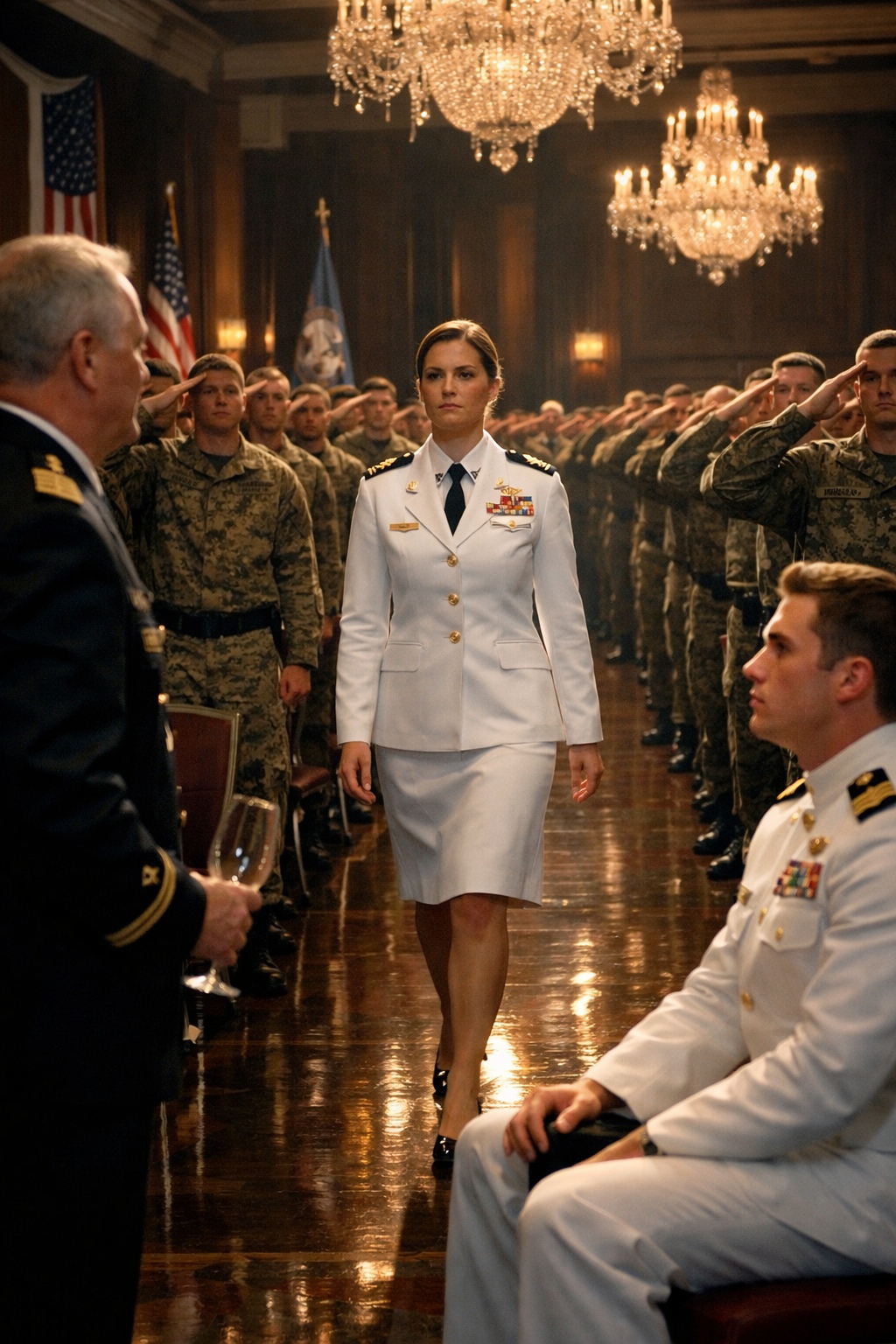
At first, confusion rippled through the room. Faces shifted from polite interest to disbelief as eyes traveled from my face to my shoulders. Three silver stars caught the chandelier light and scattered it across the hall, bright enough to hurt.
Someone gasped.
Someone whispered my name.
I walked forward.
I did not hurry. I did not pause. My heels struck the marble floor in a steady rhythm, each step measured, deliberate, anchored by years of learning how to move through spaces that had never wanted me. I had spent my career walking into rooms like this—rooms full of certainty, ego, and unspoken hierarchies—and watching them change shape the moment truth arrived.
This was no different.
In the front row, a man stiffened. He was older, his hair cut close, his posture unmistakable even before he moved. A Navy SEAL. One I recognized not by face, but by presence—the kind forged by survival and sharpened by loss.
His chair scraped back loudly.
He turned fully toward me, his eyes locking onto the stars at my shoulders.
He stood.
“Admiral Hayes,” he said.
His voice was steady. Clear. It carried.
For half a second, nothing happened.
The words hung in the air, suspended like a breath held too long.
Then another chair moved.
Another man stood.
Then another.
The sound multiplied—metal legs scraping back, boots planting firmly on the floor. It spread outward, row by row, a wave rolling across the hall. Three hundred Navy SEALs rose in perfect unison, the thunder of their movement crashing through the room like artillery fire.
Chairs slammed back. Glasses rattled. Chandeliers trembled.
The master of ceremonies froze mid-sentence. His fingers loosened. The microphone slipped from his hand and struck the floor with a shrill shriek before cutting out entirely.
Silence followed.
Not the polite kind.
The absolute kind.
I kept walking.
I felt the weight of every gaze—shock, awe, confusion, disbelief—but I did not acknowledge them. I did not salute. I did not speak. The truth did not require explanation. It was already written across my shoulders.
I reached the front row, turned, and lowered myself into an empty seat.
That single act—quiet, unannounced—shifted the entire room.
I saw my father then.
Captain Daniel Hayes.
The man who had erased my name with a signature.
He stood near the podium, a glass raised halfway to his lips, frozen in place. The color had drained from his face, leaving behind something pale and brittle. His eyes were fixed not on my face, not on my eyes, but on the stars.
On the proof he had never imagined.
The glass trembled in his hand.
Beside him, my brother Michael sat rigid, his immaculate uniform suddenly too tight, too sharp. His confident smile was gone, replaced by something raw and unguarded.
Fear.
Not of punishment.
Of comparison.
I understood it then, with perfect clarity.
They had not erased me because I was weak.
They erased me because I was dangerous to the story they told themselves.
Senior officers began to move.
A Vice Admiral approached first, his expression composed, his eyes searching my face with open respect. He extended his hand.
“It’s good to finally meet the mind behind those reports,” he said quietly.
I stood and shook his hand.
Another followed.
And another.
Each handshake was firm. Professional. Unquestioning.
No one asked why I was there.
They already knew.
One man leaned close as he shook my hand, his voice low enough that only I could hear.
“If it weren’t for you,” he said, “ceremonies like this wouldn’t even exist.”
He didn’t elaborate.
He didn’t need to.
The applause began hesitantly.
One clap. Then another.
It gathered momentum, rolling forward like a tide that could no longer be held back. This applause was not rehearsed. It was not prompted by protocol or tradition. It rose because something undeniable had entered the room and refused to be ignored.
I remained seated.
I did not bow.
I did not smile.
I let the sound wash over me, not as validation, but as acknowledgment.
For the first time in my life, I was not invisible.
When the ceremony dissolved into murmurs and movement, Michael approached me first. His steps were hesitant, his confidence stripped away.
“How long?” he asked quietly.
“Fifteen years.”
The number hit him harder than any accusation. He staggered back half a step, his breath leaving him in a rush. For the first time in his life, he was no longer the measure.
My father came last.
He stopped in front of me, close enough that I could see every line in his face, every crack in the certainty he had worn for decades. He said nothing.
His eyes moved slowly from the stars on my shoulders to my face.
Then, after a long, taut silence, he gave one slow nod.
It was not an apology.
It did not erase the years.
But it was truth.
And it was enough to break the story he had built without me.
Six months later, I returned to the old house in Norfolk.
The place looked the same—the flag outside faded by years of sun and salt, the living room arranged just as my mother liked it. But something had shifted.
In the glass cabinet that once displayed only Michael’s Naval Academy portrait, one of my medals now rested. Its ribbon lay perfectly straight, catching the light quietly.
At dinner, my father asked me questions.
Real ones.
Not polite. Not obligatory.
He asked about logistics, about intelligence coordination, about leadership in rooms where no one could raise their voice. My mother listened, her smile lighter than I remembered. Michael sat quietly, his fork still, his eyes softer.
No rivalry.
No denial.
Just recognition.
Later that night, driving away beneath the dark Virginia sky, I caught my reflection in the rearview mirror.
No shadow followed me anymore.
I smiled, just once, and whispered to myself what I had finally learned.
They never erased me.
They revealed me.
The applause did not follow me home.
That surprised some people.
They assumed that once the room stood, once the truth erupted, everything would transform instantly—that families healed in the same dramatic fashion they broke, that recognition erased absence, that one moment could undo decades.
It didn’t.
What followed was quieter. Slower. Harder.
And far more real.
In the weeks after the ceremony, my name appeared in places it never had before. Official channels. Invitations to panels. Requests for briefings. Quiet acknowledgments from people who had always known but could never say it aloud.
My father, meanwhile, retreated.
Not in anger. In reckoning.
He called once, then twice, then stopped. When we finally spoke again, it wasn’t to explain himself. It was to listen—an act that, for him, required more humility than any apology.
“I didn’t know how to see you,” he admitted one evening, his voice stripped of rank, stripped of command. “And by the time I realized it, I’d already built a life around not trying.”
I didn’t interrupt.
Because for the first time, he wasn’t speaking to defend himself.
He was speaking to understand.
My mother tried harder, faster. She sent messages filled with warmth, invitations weighted with hope. I accepted some. Declined others. Healing, I had learned, was not a performance.
Michael changed the most slowly.
Pride does not dissolve easily. Especially when it has been fed for a lifetime.
But something fundamental had shifted between us. He no longer spoke over me. No longer assumed. Sometimes he asked questions—and waited for the answer.
That mattered.
I returned fully to my work.
Not as an escape—but as an anchor.
The world did not pause because a family narrative had collapsed. Threats remained. Systems required vigilance. Lives depended on decisions made quietly, without recognition.
And I was good at that work.
Better than ever.
Because now, I carried less weight.
Not the responsibility—that remained—but the burden of invisibility. I no longer felt the need to prove my worth to people who had chosen not to see it.
I had already stepped into the light.
And chosen to stay.
Months later, I stood on a different shore.
This time, not in uniform.
The ocean stretched out before me, steady and vast, indifferent to legacy, blind to hierarchy. I watched the waves roll in and thought of the girl I had once been—the one standing at the edge of photographs, swallowing questions, learning to survive quietly.
I wished I could tell her something.
Not that she would be seen one day.
But that she would see herself.
That she would learn the difference between recognition and worth.
That she would understand this truth:
Some families teach you who you are by trying to erase you.
Some legacies are not inherited—but endured.
And some power does not announce itself.
It arrives.
And stands.
I did not become visible that day because 300 Navy SEALs stood.
They stood because I had always been visible—just not to the people who mattered least.
The greatest acknowledgment never came from my father’s nod, my brother’s silence, or the room’s applause.
It came from this:
I no longer needed to enter any room asking if I belonged.
I already knew.