In the high-stakes theater of American politics, few figures possess the cross-cultural gravity required to truly shift the public narrative. While partisan pundits and career politicians often get lost in the noise of the 24-hour news cycle, Arnold Schwarzenegger remains a singular exception to the rule.

The man who redefined the American Dream—moving from a small village in Austria to the pinnacle of bodybuilding, Hollywood, and eventually the Governor’s mansion in California—has a voice that resonates far beyond the typical Republican echo chamber. Lately, that voice has been focused on a singular, urgent mission: “terminating” the political legacy of Donald Trump.
A compilation of Schwarzenegger’s most scathing and deeply personal critiques of Trump has recently surged back into the global spotlight. It serves as a stark reminder that the “Terminator” star is not interested in mere policy debates; he is engaged in a battle for the very soul of the nation.
To understand why Arnold has become Trump’s most effective critic, one has to look past the “Apprentice” ratings feuds and into the visceral, historical imagery he uses to strip away the former President’s carefully curated tough-guy persona. It is a takedown that is as much about character as it is about the future of global stability.
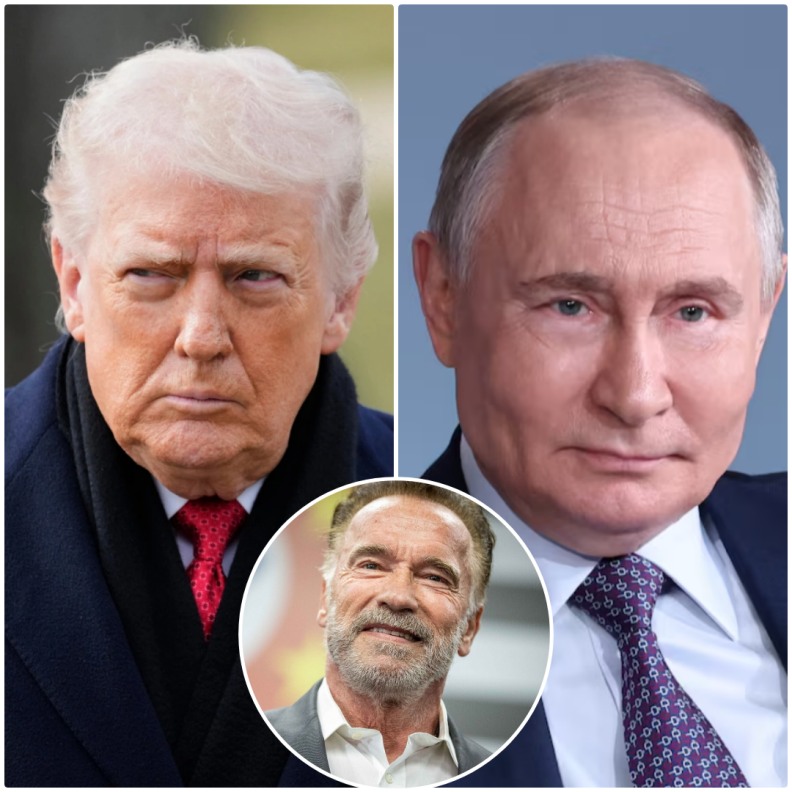
The most famous moment in this ongoing verbal war traces back to the 2018 Helsinki summit, an event that remains a dark stain on the history of American diplomacy. Standing alongside Russian President Vladimir Putin, Donald Trump appeared to side with a foreign adversary over his own intelligence agencies regarding election interference.

For Schwarzenegger, watching the President of his adopted country capitulate on the world stage was more than just a political gaffe—it was an embarrassment. “I just saw your press conference with President Putin and it was embarrassing,” Arnold said in a video addressed directly to Trump.
“I mean, you stood there like a little wet noodle, like a little fanboy,” Schwarzenegger continued, using a phrase that would instantly go viral. The imagery was devastatingly effective because it targeted the one thing Trump values most: the appearance of strength.
By comparing a world leader to a “wet noodle,” Schwarzenegger did what few others could; he made the “art of the deal” persona look fragile and subservient. He even mocked the power dynamic further, asking if Trump was going to ask Putin for an “autograph or a selfie.”
But behind the sharp wit was a deeper, more somber accusation of betrayal. Schwarzenegger declared that Trump had “sold out” the American justice system, the intelligence community, and the country itself.
He famously contrasted Trump’s performance with the legendary strength of Ronald Reagan. He reminded the world of Reagan’s “Tear down this wall” speech at the Berlin Wall, a moment of moral clarity that Schwarzenegger believes Trump utterly lacked in Helsinki.
This was not the first time the two icons clashed, as their rivalry has roots in the world of reality television. When Schwarzenegger took over hosting duties for The Celebrity Apprentice, Trump—then President-elect—frequently took to social media to mock the show’s dipping ratings.

Arnold’s retort at the time remains a masterclass in political maneuvering and humor. “Hey Donald, I have a great idea,” he suggested. “Why don’t we switch jobs? You take over TV because you’re such an expert in ratings, and I take over your job, and then people can finally sleep comfortably again.”
While these exchanges were often seen as celebrity bickering, the tone shifted dramatically following the events of January 6th. For Schwarzenegger, the riot at the U.S. Capitol was not just a political protest gone wrong; it was a terrifying echo of his own childhood.
Born in Austria in 1947, just two years after the conclusion of World War II, Schwarzenegger grew up surrounded by the “broken men” of a defeated regime. He has spoken candidly about his own father and neighbors who were misled by the lies of a charismatic leader and ended up drinking away their guilt.
In an emotional video that has since become one of the most-watched political statements in recent history, Arnold drew a direct line from the Capitol riots to Kristallnacht, the “Night of Broken Glass” in Nazi Germany. “Wednesday was the day of broken glass right here in the United States,” he stated with visible gravity.
He explained that the mob didn’t just shatter the windows of the Capitol; they shattered the very ideals that Americans have taken for granted for centuries. This comparison was not made lightly, as Schwarzenegger knows the physical and emotional cost of following a leader who governs through deception.
“I know where such lies lead,” he cautioned, warning that Trump sought a coup by misleading people with a “Big Lie.” To Schwarzenegger, the attempt to overturn a fair election was the ultimate failure of leadership, cementing his verdict that Trump will go down as the “worst president ever.”
He added a final, stinging prediction that hits Trump where it hurts most: his obsession with relevance. Schwarzenegger predicted that the former President would soon be “as irrelevant as an old tweet,” a phrase that underscored the fleeting nature of populism when compared to the endurance of democratic institutions.
The impact of Schwarzenegger’s words is bolstered by the current global reality, where American leadership is being reassessed by allies and adversaries alike. Figures like Canadian Prime Minister Mark Carney have recently spoken about a “rupture” in the international order.
Carney’s observations at Davos suggest that the world is no longer willing to rely on a volatile and isolationist superpower. The “bargain” of American hegemony, which provided stability in exchange for global influence, is crumbling as middle powers seek “strategic autonomy.”
This global shift toward “fortresses” and “new coalitions” is exactly what Schwarzenegger warned about. When a leader acts on a whim and breaks international norms, he doesn’t just affect his own country; he forces the rest of the world to protect themselves by moving on.
What makes Schwarzenegger such a potent messenger is his identity as a “moderate Republican” who believes in the beauty of the free market and the necessity of strong democratic safeguards. He is not a partisan operative; he is a patriot who believes loyalty to the country must always come before loyalty to a person.
He often quotes Teddy Roosevelt to drive this point home: “Patriotism means to stand by the country. It does not mean to stand by the president.” This philosophy is the core of his critique—that true strength is found in the protection of the Constitution, not in the ego of a single man.
As the 2026 political landscape continues to evolve, Schwarzenegger remains a vocal advocate for reform, particularly in the fight against gerrymandering and partisan rigging. He sees these as the “stinking contests” that distract from the real work of governance.
His message to the American people is one of both warning and hope. He believes that while democracy has been “shaken,” it can emerge stronger if citizens recognize the value of truth over propaganda.
In the end, the Terminator’s mission is clear: he wants to ensure that the “broken men” of his youth are never replicated in the streets of America. He wants a country where leaders are judged by their character and their respect for the law, rather than their ability to trend on social media.
By dismantling the Trump legacy, Schwarzenegger is attempting to clear the path for a new generation of leaders who understand that true power lies in unity, not division. He has seen the alternative, and he is determined to make sure America says “Hasta la vista” to the politics of lies.
The viral resurgence of his critiques suggests that his message is landing with more weight than ever before. As the world navigates a period of intense uncertainty, the voice of the immigrant who became a Governor serves as a steady reminder of what is at stake.
Schwarzenegger’s final verdict is a call to action for everyone who believes in the American experiment. It is a plea to wake up, to reject the “wet noodle” of insecurity, and to embrace the iron-clad strength of democratic values.