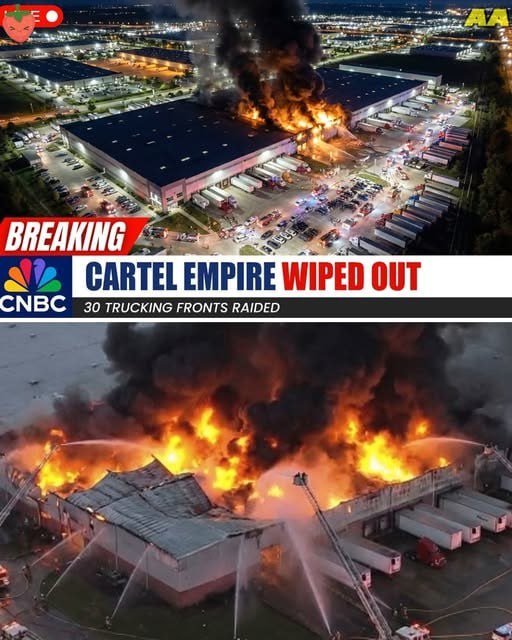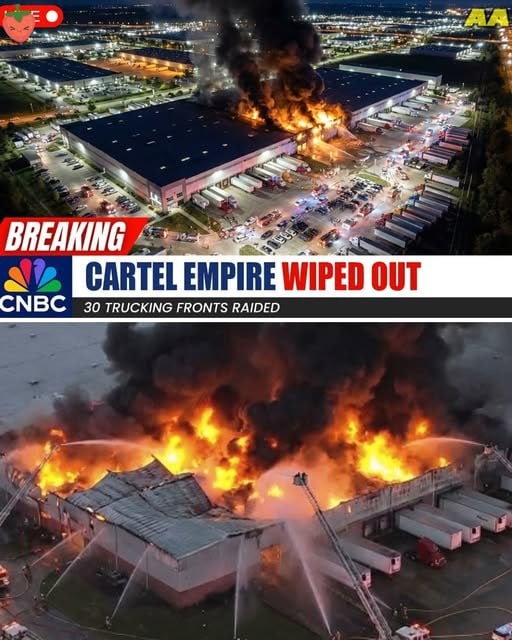
At precisely 2:49 in the morning, the silence that blanketed the town of Clovis was torn apart without warning. What had been an ordinary winter night—empty streets, darkened homes, and the hum of distant highway traffic—was instantly transformed into the opening moment of one of the most consequential federal operations in modern American law enforcement history. That minute marked the arrival of an overwhelming federal presence as agents from the Federal Bureau of Investigation and the Drug Enforcement Administration moved in unison, executing a meticulously planned raid that had been years in the making.
The immediate objective appeared modest on the surface: a residential property linked to a senior figure within the Hells Angels motorcycle club. But appearances were deceptive. What unfolded in the early hours of that January morning sent shockwaves far beyond the quiet suburban blocks of the Chicago metropolitan area. This was not merely another drug bust or gang takedown. It was the public unveiling of Operation Iron Horse—a sprawling, multi-state federal strike designed to dismantle what investigators now understood to be a highly sophisticated criminal logistics empire operating across North America.
For decades, outlaw motorcycle gangs occupied a specific and almost mythologized place in the public imagination. They were often depicted as insular groups—rebellious outsiders engaged in small-scale drug dealing, territorial disputes, and occasional bursts of violence. Law enforcement agencies largely viewed them through the same lens: dangerous, certainly, but localized. Meanwhile, Mexican drug cartels were categorized as an entirely separate threat—foreign, hierarchical, and primarily concerned with border trafficking and international smuggling routes. The prevailing assumption was that while these groups might occasionally cooperate, they remained fundamentally independent entities.
That assumption collapsed the moment federal agents forced their way into a nondescript warehouse operating under the name “Iron Freight Logistics.”
Behind steel doors reinforced to industrial standards, agents encountered a reality that permanently altered the understanding of organized crime in North America. What appeared to be a routine freight and automotive shipping hub was, in truth, the operational heart of a transcontinental smuggling network. This facility functioned as the nerve center for a partnership between the Hells Angels and two of the most powerful and violent criminal organizations in the world: Mexico’s Sinaloa Cartel and the Jalisco New Generation Cartel, commonly known as CJNG.
Operation Iron Horse made one fact unmistakably clear: the distinction between domestic criminal gangs and international drug cartels no longer existed. The boundary had not simply faded—it had been erased entirely.
Inside the warehouse, agents found evidence of an operation operating on a scale rarely seen within U.S. borders. Pallets stacked with hundreds of kilograms of near-pure methamphetamine were cataloged alongside crates containing military-style assault rifles. Refrigerated tractor-trailers—indistinguishable from thousands of others crisscrossing American highways every day—lined the loading bays. Yet these vehicles were anything but ordinary. Each one had been painstakingly modified with hidden hydraulic compartments, reinforced steel panels, and lead-lined concealment systems engineered specifically to evade advanced border detection equipment, including X-ray and radiation scanners.
The level of technical sophistication stunned even veteran investigators. These were not crude hiding spots hastily welded into truck frames. They were precision-engineered compartments requiring expert mechanical knowledge and significant financial investment. The modifications allowed millions of dollars’ worth of narcotics to be transported undetected beneath legitimate cargo such as engine parts, industrial equipment, or frozen food products.
The criminal alliance itself was a model of ruthless efficiency. Mexican cartels excelled at production: manufacturing vast quantities of narcotics at industrial scale. What they lacked was the ability to move those products seamlessly through the American interior without attracting attention. That gap was filled perfectly by the Hells Angels.
With chapters spread throughout the Midwest, the Great Lakes region, and deep into Canada, the motorcycle club already possessed something the cartels desperately needed—a deeply rooted, hyper-local presence. Members understood regional transportation routes, owned or controlled legitimate trucking companies, and held valid business licenses, permits, and customs documentation. They did not look like foreign operatives. They looked like American businessmen.
By leveraging these assets, the cartels gained access to a turnkey logistics network capable of moving narcotics with the speed, reliability, and discretion of a multinational corporation. Investigators later described the arrangement as “outsourcing logistics to domestic specialists.” The bikers handled transportation, storage, and regional distribution, while the cartels focused on production and international supply. Together, they formed a vertically integrated criminal enterprise.
As the raid continued, agents uncovered evidence that dramatically escalated the stakes. Among the seized materials were documents confirming that this specific alliance—linking the Hells Angels’ logistics arm with cartel leadership—had been formally designated by the U.S. government as a Foreign Terrorist Organization. This classification marked a seismic shift in how the group would be treated under the law.
The terrorist designation fundamentally altered the legal landscape. No longer confined to traditional organized crime statutes, federal authorities were now empowered to deploy counterterrorism tools typically reserved for extremist networks. Surveillance capabilities expanded. Financial tracking intensified. Asset seizures became faster and more aggressive. Individuals associated with the operation could now face charges tied to national security rather than standard narcotics trafficking.
Iron Freight Logistics, investigators discovered, operated with a level of professionalism comparable to major global shipping companies. The organization didn’t merely transport drugs; it managed every stage of the supply chain. It controlled warehouses, coordinated regional distribution hubs, oversaw “last-mile” delivery to local dealers, and handled the laundering of tens of millions of dollars in illicit profits through shell corporations and offshore accounts.
Drivers employed by Iron Freight maintained spotless records. Their vehicles passed inspections. Their logbooks were pristine. A routine traffic stop revealed nothing suspicious—at least on paper. Yet beneath the cargo floor of a truck carrying engine components might sit five million dollars’ worth of fentanyl, sealed inside lead-lined compartments invisible to most detection methods.
The true success of Operation Iron Horse was not measured solely by the quantity of drugs or weapons seized, though those numbers were staggering. Its real impact lay in the dismantling of infrastructure. Federal agents didn’t just intercept shipments; they dismantled the physical and digital framework that made the operation possible. Trucks were confiscated. Business licenses were revoked. Financial accounts were frozen. Communication networks were seized.
In doing so, authorities shattered the trust that held the alliance together. Cartels rely on absolute reliability from their logistics partners. Once that reliability is compromised, the entire system collapses. Operation Iron Horse proved that no matter how legitimate a criminal front appears, no network is immune to coordinated federal action.
As investigators analyzed data recovered from the warehouse, the scope of the conspiracy grew even larger. Intelligence pointed to a series of “safe corridor” routes stretching from the southwestern U.S. border through the industrial heartland and into Canada. Along these corridors, the Hells Angels acted as enforcers, using their reputation for violence and intimidation to ensure that no rival gangs interfered with cartel shipments.
They were not merely transporters—they were guardians of the supply chain, ensuring uninterrupted flow across thousands of miles. In exchange, they received protection, profit, and power that elevated them beyond traditional street-level crime.
This alliance marked the emergence of a new form of organized crime—what investigators began calling “corporate criminality.” Gone was the image of the lone biker dealing drugs on a street corner. In its place stood something far more dangerous: a boardroom-style operation overseeing a multinational enterprise designed to infiltrate legitimate commerce.
What frightened federal authorities most was not the violence, but the professionalism. The engineering expertise required to build the concealment systems, the patience involved in embedding operations within legal freight infrastructure, and the long-term strategy of economic infiltration all pointed to a criminal evolution that mirrored legitimate globalization.
When morning light finally reached the Chicago suburbs, the warehouse stood silent behind barricades and police tape. Yet the stillness was deceptive. The message had already been delivered. The hidden partnership between northern outlaw bikers and southern cartels had been exposed to the world.
Operation Iron Horse signaled the beginning of an aggressive campaign to dismantle the biker-cartel logistical empire. Early estimates suggested the seizure represented one of the largest disruptions of domestic drug distribution in DEA history, though full calculations were still ongoing.
The legal consequences are expected to unfold over many years. With terrorism-related designations now in play, prosecutions will extend beyond traditional racketeering charges into the realm of national security law. Entire financial networks are under review, and more arrests are anticipated as encrypted devices seized during the raid are decrypted and analyzed.
The quiet neighborhoods of Clovis and the industrial zones of the Midwest had unknowingly served as battlegrounds in a hidden war. For one pivotal night, the federal government seized the advantage. The Iron Horse had been crippled, and the illusion of invulnerability surrounding the biker-logistics elite was shattered beneath the weight of federal indictments.
The investigation continues to ripple outward, revealing a blueprint for how the modern drug trade operates in the twenty-first century—by hiding within ordinary systems, exploiting the infrastructure of global commerce, and delivering destruction under the cover of legitimacy. Federal authorities have made their stance clear: the trucks may look ordinary, but the threat they carry has never been greater, and the pursuit of those who move it has never been more relentless.