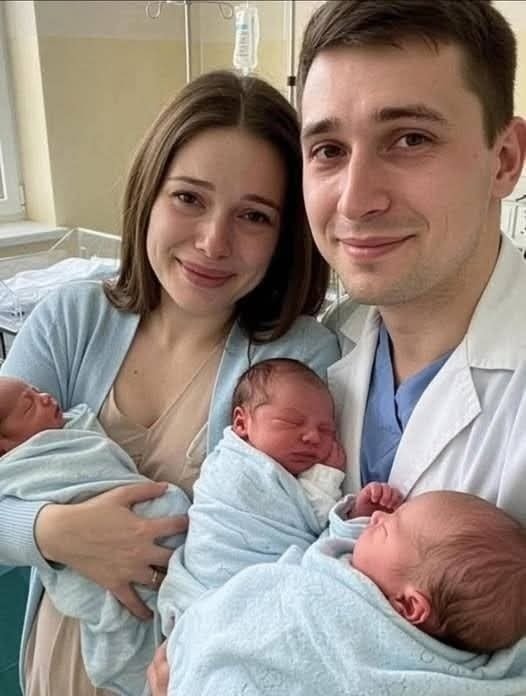
A Medical Emergency That Changed Everything
For most parents, the moment of welcoming a child into the world is unforgettable. For one mother in Texas, however, that moment was entirely erased from memory by a rare and severe medical emergency that pushed her body to the brink of survival.
At 30 years old, Marisa Christie experienced a life-threatening complication during childbirth that left her without a heartbeat for an extended period of time. When she eventually regained consciousness days later, she woke to a reality she could not remember: she had given birth to triplets.
What followed was not only a physical recovery, but an emotional and psychological journey that reshaped how she viewed herself, her family, and life itself.
A Planned Birth That Took an Unexpected Turn

Marisa, who lives in Tomball, Texas, was already a mother when she became pregnant with triplets. Together with her husband, Dylan Christie, she was preparing to welcome three baby girls into their growing family.
Due to the nature of a multiple pregnancy, doctors scheduled a planned cesarean section. By all outward appearances, the procedure began as expected. The babies were delivered safely, and the medical team followed standard post-delivery practices.
But within moments, the situation changed dramatically.
The Sudden Onset of a Rare Complication

Shortly after the delivery, Marisa began experiencing seizures. Medical staff quickly recognized that something was seriously wrong. Her condition deteriorated rapidly as her heart stopped, and she ceased breathing.
Doctors immediately initiated emergency measures. Despite extensive efforts, Marisa showed no signs of cardiac activity for a prolonged period. Medical professionals later described her as being clinically unresponsive while they continued life-saving interventions.
This was not a typical childbirth complication. It was later identified as a rare condition known as amniotic fluid embolism.
Understanding Amniotic Fluid Embolism
Amniotic fluid embolism, often abbreviated as AFE, is an extremely rare and unpredictable childbirth emergency. According to the Cleveland Clinic, it occurs when amniotic fluid or fetal material enters the mother’s bloodstream, triggering a severe reaction.
The condition can cause sudden cardiovascular collapse, respiratory failure, and significant bleeding. It is not preventable, and it often occurs without warning, even in otherwise healthy pregnancies.
In Marisa’s case, the reaction led to massive blood loss and cardiac arrest, requiring immediate and sustained medical intervention.
Fighting to Save a Life

As Marisa’s condition worsened, a team of doctors, nurses, and specialists worked simultaneously to keep her alive. Cardiopulmonary resuscitation was performed while others attempted to control bleeding and replace lost blood.
Medical staff later explained that she lost an amount of blood equivalent to her entire blood volume. For an extended period, her body showed no measurable signs of circulation, yet the team continued their efforts.
Ultimately, doctors made the difficult decision to perform emergency surgery to remove her uterus, a step that was necessary to stop the bleeding and stabilize her condition.
A Week in Unconsciousness
After the emergency procedures, Marisa remained unconscious for approximately one week. During this time, her body slowly began to recover from the trauma it had endured.
Her family waited anxiously, uncertain of the outcome. While the newborn triplets were healthy and receiving care, their mother’s survival was still uncertain.
When Marisa finally regained consciousness, she had no memory of the delivery or the critical events that followed.
Waking Up to an Unimaginable Reality
As Marisa became aware of her surroundings, she was confused and disoriented. It was then that her husband gently explained what had happened.
He told her that the babies had been born, that they were healthy, and that she was now the mother of three newborn daughters.
The news was overwhelming. Marisa later shared that the realization brought fear as much as relief. The absence of memory made the experience feel unreal, as if it had happened to someone else.
Meeting Her Daughters for the First Time
By the time Marisa was able to meet her babies, they were already more than a week old. The girls—named Charlotte, Kendall, and Collins—were thriving, but their mother struggled to feel an immediate connection.
She described feeling emotionally detached at first, unsure how to process the sudden shift in her reality. This reaction, medical professionals note, is not uncommon after severe medical trauma and extended unconsciousness.
Despite her initial uncertainty, Marisa noticed that her babies responded to her voice and presence, a subtle reassurance during a confusing time.
The Psychological Aftermath of Trauma
Surviving a life-threatening medical emergency often leaves lasting emotional effects. Marisa later acknowledged that she felt disconnected from the person she had been before the experience.
Such feelings are frequently associated with trauma recovery. Patients may experience changes in identity, perception, and emotional processing after events that challenge their sense of safety and continuity.
Marisa’s recovery was not only about healing her body, but also about understanding how the experience had altered her outlook on life.
Support From Family and Medical Professionals
Throughout her recovery, Marisa relied heavily on the support of her husband, family, and healthcare providers. Open conversations, patience, and professional guidance played a key role in helping her adjust.
Doctors emphasized the importance of monitoring both physical and mental health following severe childbirth complications. Counseling and ongoing care are often recommended to help patients navigate emotional recovery.
Marisa’s openness about her struggles has contributed to greater awareness of the long-term effects of medical trauma.
Life After Survival
Today, Marisa has physically healed from the emergency, though she acknowledges that the emotional journey is ongoing. She describes herself as stronger, but fundamentally changed.
The experience reshaped her priorities and perspective, reinforcing how fragile and unpredictable life can be. While she continues to adapt to her new normal, she has embraced motherhood once again, now with three additional children.
Her story is not one of fear, but of survival, resilience, and the complexity of recovery.
Raising Awareness About Rare Childbirth Risks
While amniotic fluid embolism is extremely uncommon, Marisa’s experience highlights the importance of preparedness and rapid medical response. Even in well-planned births, unexpected complications can arise.
Medical experts stress that such cases are not the result of mistakes or neglect, but rather the unpredictable nature of certain biological reactions.
Sharing stories like Marisa’s helps educate the public while honoring the efforts of medical teams who work under immense pressure to save lives.
A Story of Survival and Perspective
Marisa’s journey serves as a reminder that survival is sometimes followed by questions, uncertainty, and emotional rebuilding. Recovery is not always linear, and it often extends beyond hospital walls.
Her experience has sparked conversations about maternal health, trauma-informed care, and the need for compassion toward those recovering from unseen wounds.
Ultimately, her story stands as a testament to medical dedication, family support, and the human capacity to adapt after unimaginable events.
Moving Forward With Gratitude and Caution
As Marisa continues raising her children, she does so with a deeper awareness of life’s unpredictability. While the past cannot be changed, her willingness to share her experience offers reassurance to others facing medical uncertainty.
Her story is not defined by the moment her heart stopped, but by the strength it took to move forward afterward.
In that sense, it is not only a story about childbirth or medicine, but about resilience, recovery, and the quiet courage required to begin again.