
In the high-octane world of modern cable news, the atmosphere is almost always engineered for maximum noise and constant friction.
Producers and hosts typically rely on a predictable rhythm of interruption, escalation, and carefully curated conflict to keep the audience’s adrenaline pumping.
Rarely does a guest manage to break that rhythm, and even more rarely does a guest manage to stop the entire machinery of a newsroom in its tracks.
However, during a recent live segment featuring Karoline Leavitt, the world witnessed something that felt less like a political debate and more like a profound shift in the media landscape.
It wasn’t a raised voice or a sharp insult that captured the collective attention of millions; instead, it was the absolute absence of sound.

The moment, now famously referred to as the “eleven seconds of silence,” has become a case study in how to navigate hostile media environments.
From the very start of the broadcast, the setup followed a familiar and arguably tired pattern seen on major networks like CNN.
The host sat ready with a practiced, skeptical expression, his body language suggesting he was prepared to pounce on any response Leavitt offered.
In this ecosystem, the goal is often to prevent the guest from finishing a thought, thereby maintaining control over the narrative and the clock.
But as the segment began, it became immediately clear that Leavitt had no intention of participating in the standard back-and-forth shouting match.
Instead of reacting with the expected defensiveness or partisan fire, she maintained a level of calm that seemed almost out of place for the setting.
With a deliberate and steady hand, she reached into her binder and pulled out a single sheet of paper, adjusting her microphone as if preparing for a lecture.
“Let’s look at the record,” she stated, her voice devoid of the usual tremors of agitation or the artificial excitement of a talking point.
That one simple sentence acted as a catalyst, shifting the entire temperature of the room from a heated argument to a focused examination.
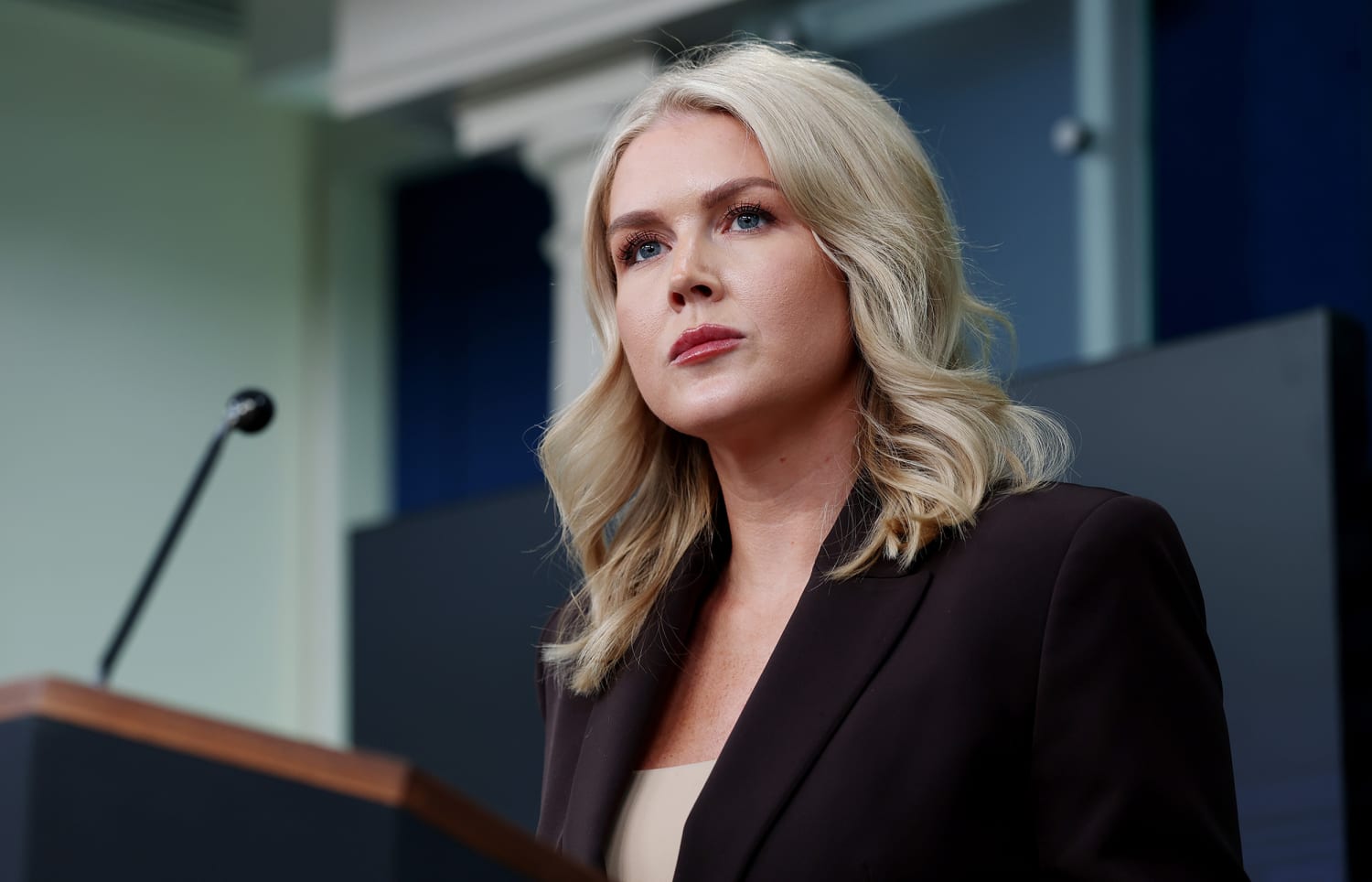
What followed was a masterclass in the power of the primary source, a tool that is frequently neglected in the era of “vibes-based” journalism.
Leavitt began to read—slowly, clearly, and without any added flavor—the actual public record and verbatim quotations of Representative Ilhan Omar.
She cited Omar’s specific statements on complex foreign policy issues that have long been the subject of national debate and scrutiny.
She referenced specific votes related to national security, reading the exact legislative language that Omar had supported or opposed in the past.
There was no attempt to “spin” the information, no snarky commentary, and no use of inflammatory adjectives to bias the listener.
By presenting the information in its rawest form, Leavitt removed the traditional scaffolding that many political figures use to shield themselves from criticism.
Normally, a debate is sidetracked by “tone policing” or arguments over context, but you cannot argue with a direct quote being read from a public file.
The host, who had been leaning in to provide the usual “fact-check” or redirection, found himself suddenly frozen in the middle of a gesture.
He opened his mouth as if to offer a counterpoint, but the sheer gravity of the verbatim text seemed to leave him without a logical entry point.
As Leavitt continued to read, the quotes began to pile up, each one standing on its own as an undeniable piece of the historical and political record.
Then, the unthinkable happened in the world of live, multi-million-dollar television production: the room went completely and utterly silent.
For eleven full seconds, there was no cross-talk, no frantic redirection from the host, and no emergency cutaway to a commercial break.
In the language of television, eleven seconds is not just a pause; it is an eternity that signals a total loss of control over the broadcast.
Viewers at home could sense the palpable tension through their screens as the cameras remained fixed on the participants, neither of whom spoke.
The silence held a weight that words could not carry, suggesting that the facts being presented were so clear they required no further explanation.
It was a moment where the “script” of the news cycle simply broke, leaving the audience to sit with the reality of the information provided.
Why did this brief period of dead air resonate so deeply with people from across the entire political spectrum?
The answer lies in the growing public exhaustion with performative debates that prioritize “gotcha” moments over substantive, factual information.
By refusing to get angry, Leavitt denied the host the opportunity to frame her as an “outraged” or “unreasonable” partisan actor.
When a guest stays calm and sticks to the documented facts, the host is forced to either acknowledge those facts or look foolish trying to ignore them.
In this instance, the host’s inability to immediately pivot or refute the material was interpreted by many as a silent admission of the material’s accuracy.
Social media erupted almost instantly, with clips of the exchange garnering millions of views and thousands of comments within the first hour.
Users noted that the silence was “louder than any monologue,” highlighting the rare occurrence of a guest actually using the public record as a shield.
Reports from media insiders later suggested that the control room was in a state of absolute chaos during those eleven silent seconds.
Producers were reportedly scrambling to decide whether to cut to a break or attempt to steer the conversation back to a more “manageable” topic.
The delay in their reaction only served to emphasize the effectiveness of Leavitt’s approach, making the network look unprepared for a factual discussion.
By the time the host finally managed to pivot awkwardly to a new subject, the damage—or the impact—had already been firmly established.
Leavitt simply closed her binder with a knowing smile, having successfully navigated the “lion’s den” without ever raising her voice.
This event serves as a powerful reminder that in an age of constant misinformation and digital noise, the truth remains the ultimate disruptor.
When you strip away the layers of interpretation and emotional manipulation, the public record is often the only thing that cannot be argued away.
Leavitt didn’t need to be a better “debater” in the traditional sense; she simply needed to be the one holding the most accurate receipts.
The 11-second freeze was a “glitch” in a system that usually filters reality through a very specific lens to suit a desired narrative.
For a few brief moments, the filter failed, and the audience was allowed to see the facts as they truly are, unadorned and unmanipulated.
As we move forward into an increasingly polarized political climate, the “Leavitt Method” will likely be studied by communicators everywhere.
It proves that the most effective way to win an argument isn’t necessarily to speak the loudest, but to speak the truth most clearly.
The silence that followed her reading of the record was the sound of a narrative being dismantled in real-time, live on national television.
It was a victory not just for a political side, but for the concept of transparency and the importance of holding leaders accountable to their words.
While the network may try to edit the clip or move on to the next scandal, the image of that silent studio remains burned into the public consciousness.
It stands as a testament to the fact that sometimes, the most revolutionary thing you can do is simply read the record, line by line.