America is used to waking up to breaking news.
But this time, some people didn’t sleep at all.
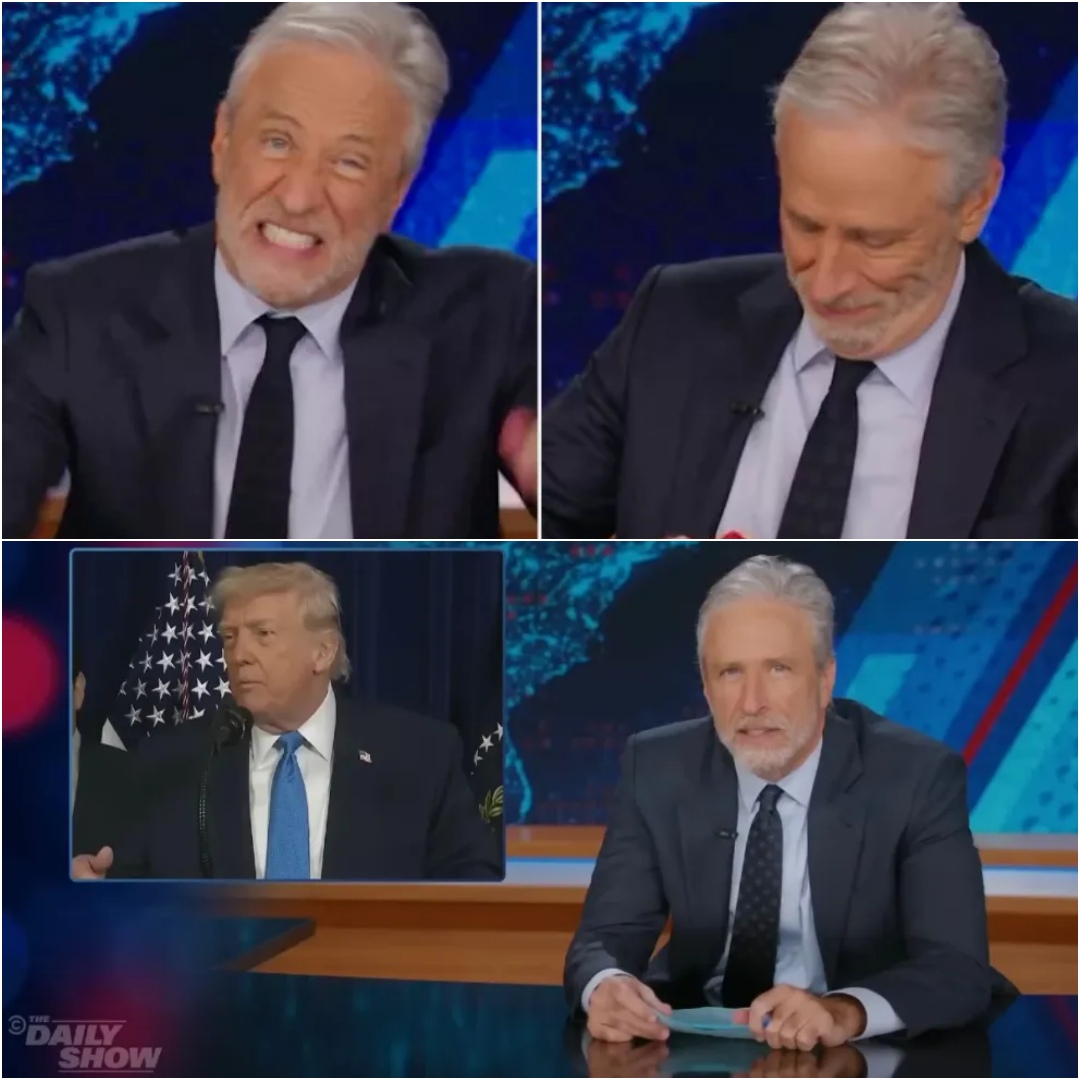
Because at roughly 3 A.M., while much of the country was still in darkness, a surprise livestream popped up — no intro music, no studio, no applause, no jokes.
Just Jon Stewart, sitting in a dim room, lit by a weak light, looking exhausted and guarded, speaking in a tone so quiet and serious that longtime fans instantly knew:
Something was different.
And what shook people wasn’t just what Stewart said.
It was when he said it — in the middle of a national flare-up over high-profile ICE confrontations, d3adly force, and a rapidly intensifying political battle about who counts as an American citizen.
Stewart opened with a line that didn’t sound like comedy or commentary. It sounded like a warning:
“The truth is dangerous. But staying silent is worse.”
Then he claimed he had been under “immense pressure” to stop talking about certain developments — and added, almost as if he didn’t want to say it out loud:
“I’ve been warned… more than once.”
That’s when millions of viewers asked the same question:
What is he talking about? And who is he afraid of?

Why the Livestream Suddenly Feels Specific: America Is Already Exploding Over ICE and Federal Force
If Stewart had gone live like this during a quiet month, it might have been dismissed as a strange moment.
But he didn’t.
He went live during one of the most combustible periods the country has seen in years — because the political temperature is being driven by multiple overlapping flashpoints:
1) Minneapolis: An ICE sh00ting that sparked outrage
One of the most widely discussed incidents involves a d3adly ICE confrontation in Minneapolis, which immediately triggered nationwide debate about what happened, whether the force was justified, and whether official accounts match what people saw and heard.
Officials have defended federal actions, while critics argue the public is being asked to accept too much, too quickly — and without the transparency people demand when a life is lost.
2) Portland: Another violent federal clash, with more questions
Not long after, a separate federal confrontation in Portland ignited more demonstrations and renewed scrutiny over the use of force in enforcement operations.
And once multiple incidents happen close together, the argument shifts.
It stops being “one case.”
It becomes a broader question:
Is enforcement escalating? And are we seeing the start of something bigger?
3) A wave of protests spreading across states
From Minneapolis to Portland, protests and outrage spread rapidly — and not just among activists, but also among ordinary Americans who don’t typically march, but are disturbed by the direction things appear to be heading.
That’s why Stewart’s livestream didn’t feel random.
It felt like it was speaking directly into a national anxiety that already existed.

The Line That Truly Set Off Panic: “If My Voice Disappears…”
Stewart didn’t bring names.
He didn’t release documents.
He didn’t directly accuse a person or an agency of threatening him.
But he said something far more psychologically explosive:
“I am documenting everything. If my voice suddenly disappears, know that it wasn’t my choice.”
That single sentence shifted the entire meaning of the livestream.
Because it didn’t sound like a political opinion.
It sounded like the language of someone preparing for retaliation — like someone trying to create a record that he was not choosing silence.
And the way the stream ended — abruptly, without a goodbye — only intensified that feeling.
Why His Vagueness Made It Worse (And Why It Might Be Deliberate)
Some people criticized the livestream for being too vague.
Others said the vagueness made it more credible.
And that’s because there’s a logic to vagueness in moments like this:
If someone believes speaking too directly could cause consequences, they may speak in a way that is:
-
clear enough for audiences to sense the danger
-
but vague enough to avoid legal risk or immediate backlash
That is the language of someone walking a tightrope.
It’s not the language of entertainment.
It’s the language of caution.
The Second “Hot Topic” That Makes Stewart’s Livestream Even Heavier: The Birthright Citizenship Battle
At the same time ICE controversies are dominating headlines, another conflict is building — one that could reshape America for decades:
birthright citizenship.
The debate touches a question that goes beyond immigration policy:
Who gets to be an American — and who gets to decide?
And as legal battles move toward national institutions and courts, the issue becomes more than politics.
It becomes identity.
It becomes constitutional.
It becomes existential.
So when Stewart appears at 3 A.M. talking about “truth,” “pressure,” “warnings,” and the danger of silence, people don’t interpret it in a vacuum.
They interpret it inside a country that is arguing over:
-
the power of federal enforcement
-
the boundaries of due process
-
the legitimacy of state force
-
and the very definition of citizenship
In that climate, his livestream lands like gasoline on a smoldering fire.
The Key Point: Stewart Wasn’t Just Hinting at “A Story” — He Was Pointing to “A System”
The most important thing about the livestream is not whether Stewart has a secret file.
It’s what the livestream implies about the atmosphere he believes America is living in:
-
that there are things you “aren’t supposed to say”
-
that power may be expanding
-
that there is pressure to self-censor
-
and that speaking openly may come with real consequences
Whether or not that fear is justified, the fact that it resonates with millions is the real story.
Because a healthy democracy depends on public trust.
And when trust collapses, even a short, vague livestream can feel like the beginning of a larger crisis.
Why the Media Is Careful — But the Public Isn’t
Mainstream outlets tend to treat moments like this with caution:
-
No evidence has been presented.
-
No official confirmation.
-
No named targets.
But the public does not operate like a newsroom.
The public operates emotionally — and people are already looking at the same picture:
-
d3adly or controversial enforcement incidents
-
national protests
-
the tightening of immigration enforcement
-
expanding rhetoric about threats and “terrorism”
-
a looming constitutional fight over citizenship
-
and deep distrust in institutions
So when Stewart says “I’ve been warned,” people don’t wait for footnotes.
They react.
Stewart May Not Have Revealed Anything — But He Did Something More Powerful
Stewart might eventually explain the livestream.
He might come back and say it was about media pressure.
He might release a major investigative story.
Or he might stay silent.
But no matter what happens next, the livestream already accomplished something:
It exposed how fragile the American public feels right now.
Because the real shock wasn’t Stewart’s words.
The real shock was how quickly millions of people believed the possibility that a voice could be pressured into disappearing.
That belief — even if it’s only fear — is a cultural warning sign.
And Stewart’s livestream, short as it was, asked the country a question that doesn’t go away when the video ends: