Live television has always thrived on danger. There is something electric about knowing that what you’re watching has no safety net—no second takes, no edits, no erasing a moment once it escapes into the world. And few shows understood how to dance on that edge better than The Carol Burnett Show.
Week after week, the series balanced carefully crafted sketches with the ever-present possibility of collapse. A missed cue, a cracked smile, a line delivered too perfectly—any of it could send the entire cast spiraling into uncontrollable laughter. And the audience loved it when that happened.
But among all the legendary near-disasters in the show’s long run, one sketch stands above the rest. Not because it was especially clever on paper. Not because the premise was groundbreaking. And certainly not because it was meant to become iconic.
It became legendary because of Harvey Korman’s legs.
A Sketch That Looked Innocent on the Page
The idea, when it first surfaced in the writers’ room, was unremarkable. A short comedy bit. Five minutes, maybe less. A mild setup built around embarrassment and obligation—two things sitcom comedy has relied on since the beginning of time.
The premise was simple: a conservative, tightly wound man finds himself forced to participate in a PTA fundraising event that requires him to dress in drag. He hates it. He resents it. He’s deeply uncomfortable with every second of it. Comedy, the writers assumed, would come from his mortification.
It wasn’t edgy. It wasn’t daring. It wasn’t even particularly outrageous for the era. The humor lived in character reactions and quick exchanges, not spectacle.
On the page, it looked safe.
No one—not the writers, not the producers, not even the performers—anticipated what would happen once Harvey Korman stepped into costume.
The Entrance That Changed Everything
When the curtain rose, the audience didn’t ease into laughter. They detonated.
There was no warm-up chuckle, no polite ripple of amusement. Instead, the studio filled instantly with shrieks, gasps, and uncontrolled howling. The reaction was so immediate and so loud that it briefly overpowered the dialogue entirely.
The reason was standing center stage.
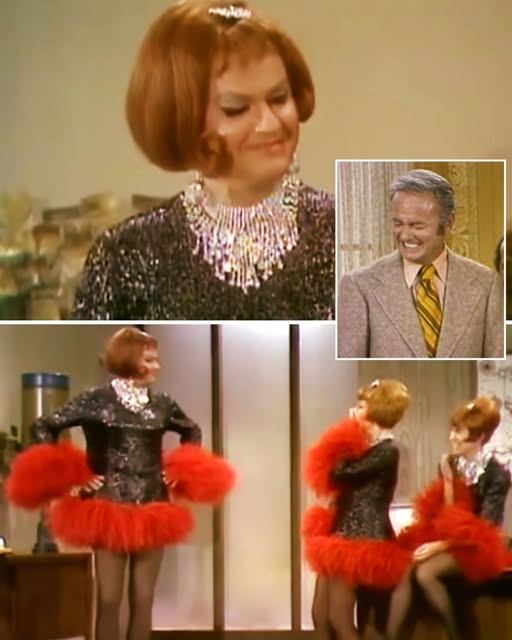
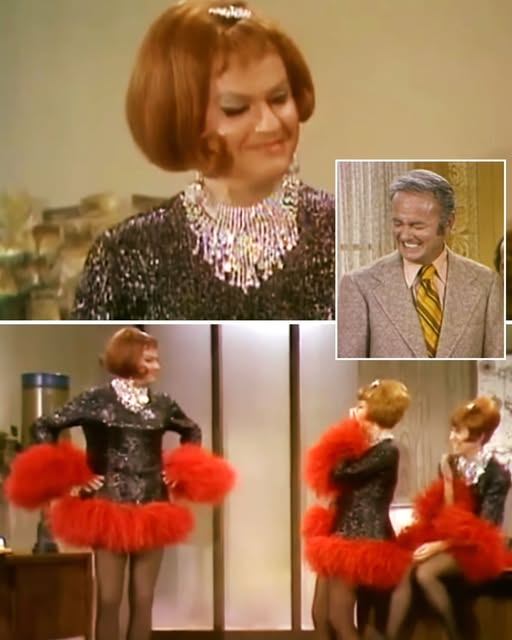
Harvey Korman—tall, broad-shouldered, and famously composed—had been transformed. At six feet two inches, he loomed above the set, balanced precariously in high heels that seemed to challenge gravity itself. His legs, long and startlingly shapely, were displayed with unapologetic prominence. The costume shimmered with a kind of reluctant elegance, as though it resented being worn by someone who despised it.
And then there was the walk.
It was not graceful. It was not confident. It was not subtle. It was a chaotic blend of wobble, defiance, and pure survival instinct. Each step looked like a negotiation between pride and physics. The audience watched, transfixed, as Harvey advanced with the determination of someone who knew retreat was impossible.
This was no longer a sketch. This was an event.
Carol Burnett Strikes First
Carol Burnett took in the scene with the sharp instincts of a performer who knew exactly when lightning had struck. She didn’t rush. She didn’t overplay it. She let the audience feel the moment breathe.
Then she smiled—that knowing, impish smile that had undone countless co-stars before—and delivered a line that landed with surgical precision.
She commented on his legs.
The remark was simple, almost casual, but devastatingly effective. It reframed the entire sketch in an instant. What had been about embarrassment was now about undeniable, inconvenient beauty.
Harvey, a master of restraint, responded with absolute seriousness. No wink. No grin. Just a dry, familial explanation that somehow made the situation even funnier. The contrast between his dignity and his appearance created a tension the audience could barely handle.
Carol, sensing blood in the water, pressed further. Her follow-up line expanded the joke sideways, twisting the family lineage into something hilariously tragic.
The laughter that followed wasn’t polite or measured. It was the kind of laughter that knocks the breath out of your chest. The kind that makes people clap without realizing they’re doing it.
Even Harvey’s famously ironclad composure began to show cracks. His face twitched. His eyes betrayed him. The battle to remain serious was clearly being lost.
When the Sketch Refused to Behave
From that moment on, the sketch no longer belonged to the script. It had its own momentum, its own personality, and its own sense of mischief.
Carol escalated the situation by casually announcing that the character would need to walk several blocks through the city while dressed this way. The idea hit Harvey like a physical blow. His reaction—indignant, horrified, utterly sincere—sent the audience into another frenzy.
His protest felt real. Too real. It was the kind of reaction that blurs the line between character and performer, and the audience could sense that they were witnessing something dangerously close to genuine panic.
Carol responded without hesitation, firing off a comparison so unexpected and so perfectly timed that it became one of those lines people repeat decades later.
The laughter surged again, louder than before.
Harvey turned away, announcing his exit with dramatic outrage. His heels struck the floor with sharp, echoing clicks, each step punctuating his fury. It was absurd. It was theatrical. It was magnificent.
And then Carol delivered the line that would give the sketch its immortality.
She called after him, her tone syrupy and sincere, and described him as beautiful in his anger.
Without turning back, Harvey shot off a threat that sounded less like dialogue and more like a promise. The crowd lost whatever composure it had left.
Total Breakdown Behind the Desk
At this point, most sketches would have ended. The energy had peaked. The laughs had landed. But this one still had one final obligation: a scene with the boss.
Harvey returned, still in costume, still simmering, still trying desperately to hold onto the last fragments of control. The setup was straightforward. He would offer a simple explanation for his appearance. One line. Clean and quick.
He never stood a chance.
The laughter was relentless. Carol could barely look at him. The director, unseen but not unheard, was reportedly struggling just to breathe. Harvey’s voice wavered. His wig threatened mutiny. The entire production teetered on the edge of implosion.
Then the boss delivered his line.
It mirrored Carol’s earlier remark, landing like a perfectly aimed echo. The symmetry was fatal.
Everything collapsed.
Carol doubled over. Harvey abandoned any attempt at seriousness. Words dissolved into noise. The audience roared with the kind of laughter that becomes communal, almost primal.
There was no saving it. There was only surrender.
The Exit and the Aftermath
Harvey fled the stage—not as a character, but as a man who knew he had nothing left to give. Later, when asked why he left so abruptly, he offered a dry explanation that perfectly captured the spirit of the moment.
He knew that if he stayed, they would demand more. And his body—specifically his ankles—had already given all they could.
The remark became part of the legend, a footnote that only enhanced the story.
Why the Sketch Still Matters
Today, the sketch is remembered not for its storyline or its premise, but for its chemistry. For the way seasoned professionals lost control together. For the joy of watching performers push each other just far enough to break.
It’s remembered because it captures something rare: the sound of people discovering comedy at the exact same moment it happens.
Harvey Korman, towering and trembling in heels, became something unexpected that night. He wasn’t just the straight man. He wasn’t just the victim of the joke.
He was radiant.
And Carol Burnett, ever the ringmaster, stood beside him and let the chaos bloom.
Live television doesn’t offer many gifts that last forever. But once in a while, it delivers something perfect—unplanned, uncontrollable, and unforgettable.
That night, Harvey Korman didn’t just make people laugh.
He became legendary.