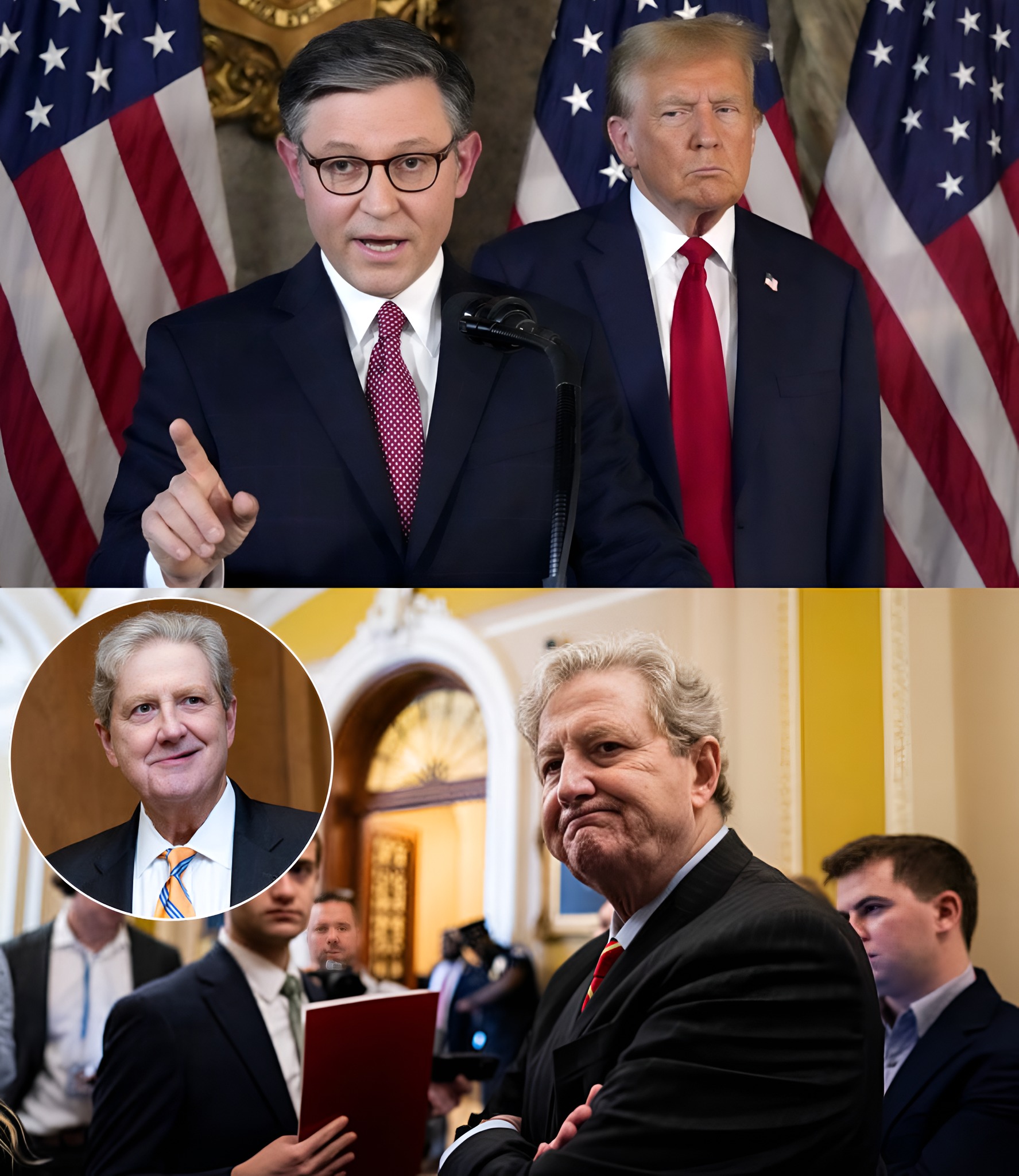
Senator John Neely Kennedy did not simply launch a reelection campaign, he detonated a political device that forced Washington to confront power, loyalty, and independence in a way that felt uncomfortable, deliberate, and impossible to ignore.

Instead of avoiding Donald Trump’s verbal attacks or downplaying them as political theater, Kennedy placed Trump’s own words front and center, exposing their tone. aggression, and instability without commentary, allowing voters to hear raw dominance language stripped of applause or tribal reinforcement.
The effect was jarring because the insults sounded smaller when isolated, not powerful, not commanding, but restless, defensive, and oddly insecure when removed from rallies and placed against silence and Kennedy’s unblinking. composure.
Then Kennedy appeared, not angry or theatrical, but still, controlled, and deliberate, delivering a line that reframed the entire confrontation by asserting independence without aggression and strength without submission, destabilizing the normal emotional script of political conflict.
His refusal to shout, posture, or dramatize created a psychological vacuum where the audience had to do the interpretive work themselves, making the contrast between bullying rhetoric and composed resistance feel sharper than any verbal attack could have.
What made the moment viral was not volume but restraint, because political culture has trained audiences to expect noise as power, and Kennedy inverted that expectation by letting calm become the dominant force on screen.

This was not a rebellion against Trump, not a betrayal, and not an ideological pivot but a boundary-setting act framed as character rather than conflict, which made it more threatening to traditional power hierarchies than open defiance ever could.
By refusing to frame Trump as an enemy. Kennedy instead framed himself as immune to intimidation, which quietly reframed Trump’s attacks as irrelevant rather than dangerous, an approach that unsettled both supporters and critics simultaneously.
Political operatives immediately recognized the shift, because the ad did something most campaigns avoid, which is risk emotional ambiguity instead of tribal certainty. forcing audiences to pause rather than react automatically along partisan lines.
That pause was the real weapon, because it disrupted the automatic loop of outrage and loyalty that dominates modern political media, replacing it with a moment of cognitive friction that demanded interpretation instead of reflex.
In doing so, Kennedy repositioned himself not as a follower or rebel but as an independent actor, which is far more destabilizing to political hierarchies than either loyalty or opposition because it refuses to accept the legitimacy of either role.
This strategy resonates in a political environment where voters increasingly distrust theatrical conflict and performative outrage, seeing them as substitutes for competence, seriousness, and responsibility rather than evidence of strength or conviction.
Kennedy’s ad therefore operated on two levels simultaneously, functioning as a campaign announcement while also serving as a meta-commentary on how political power is performed, enforced, and psychologically internalized by both leaders and followers.
By choosing clarity over combat, Kennedy implicitly criticized the emotional economy of modern politics, where volume replaces substance and confrontation replaces accountability, exposing the system without attacking it directly.
This made the message harder to dismiss because it did not ask for agreement, sympathy, or outrage, only observation, which is far more difficult for ideological opponents to attack without appearing defensive or reactive.
The result was a rare political moment that did not tell voters what to feel but instead created a situation where feeling emerged organically, often in ways that surprised people who expected either fury or submission.
Supporters saw quiet courage, critics saw veiled arrogance, strategists saw calculated positioning, and institutional power saw something more dangerous than rebellion, which is the refusal to participate in the emotional rituals that sustain hierarchy.
The ad worked because it denied its audience the emotional payoff they have been conditioned to expect, which paradoxically made it more compelling, shareable, and unsettling than any dramatic confrontation could have been.
Instead of creating enemies, Kennedy created uncertainty, and uncertainty is more disruptive than anger because it cannot be easily categorized, attacked, or dismissed using existing political narratives and reflexes.
That uncertainty rippled through media ecosystems because commentators could not immediately agree on whether the ad was loyal, hostile, defiant, submissive, or something else entirely, which kept the conversation alive rather than resolved.
By refusing to explain himself beyond one calm statement, Kennedy preserved ambiguity, forcing analysts, journalists, and voters to fill in the meaning themselves, effectively outsourcing narrative creation to the audience rather than controlling it directly.
This tactic leverages a psychological principle where people are more invested in meanings they construct themselves than meanings delivered to them, making the ad more persuasive precisely because it was less explicit.
In contrast, Trump’s words, once extracted from their emotional environment. appeared performative rather than commanding, reactive rather than strategic, and dependent on audience response rather than inherently authoritative.

Kennedy’s stillness functioned as a mirror, reflecting the performative nature of political aggression back to itself without commentary, which stripped it of mystique and recast it as noise rather than power.
This reframing subtly challenges a core assumption of modern populism, which is that loudness equals authenticity and dominance equals strength, suggesting instead that control, discipline, and independence may be more durable forms of authority.
For Washington insiders, this represented a potential shift in campaign logic, where emotional escalation is no longer the only viable strategy for breaking through media saturation and voter fatigue.
For voters exhausted by constant outrage, the ad felt like a psychological relief, offering an alternative to the emotional overload that defines contemporary political engagement and leaves many feeling manipulated rather than represented.
For party leadership, however, the ad was unsettling because it normalized independence, and independence is dangerous to centralized power structures that rely on emotional alignment, loyalty rituals, and controlled conflict to maintain cohesion.
Kennedy’s message implicitly argued that loyalty does not require obedience, that unity does not require silence, and that disagreement does not require hostility, a framing that destabilizes traditional partisan control mechanisms.
This reframing threatens both ideological camps because it weakens the emotional incentives that keep voters locked into binary thinking, replacing them with a model of political identity based on autonomy rather than affiliation.
That autonomy is precisely what makes the moment powerful, because it invites voters to imagine themselves as independent evaluators rather than loyal participants in a permanent emotional war.
The ad therefore does not simply promote Kennedy, it challenges the psychological architecture of modern political media, which depends on emotional extremes to drive engagement, loyalty, and behavioral predictability.
By stepping outside that architecture, Kennedy made himself harder to control, harder to categorize, and harder to attack, which is strategically valuable in a system built around predictable outrage cycles.
This is why the moment felt larger than a campaign announcement, because it disrupted expectations about how power should look, sound, and behave in a media-saturated political environment.
The silence after his statement was not empty, it was loaded, forcing the viewer to sit with unresolved tension rather than offering immediate emotional resolution or ideological comfort.
That unresolved tension became the hook, making the ad memorable not because of what was said, but because of what was left unsaid, which is far more difficult to forget.
In that sense, Kennedy did not dominate the moment, he vacated it, allowing the absence of noise to become the message itself, which paradoxically made the moment louder than any speech could have been.
This inversion of political theater represents a subtle but meaningful shift in how authority can be performed in the digital age, where saturation makes subtlety more disruptive than spectacle.
Whether voters ultimately reward or reject this approach remains uncertain, but its immediate impact on the political conversation is undeniable, because it introduced a new grammar into a language dominated by shouting.
That grammar does not rely on enemies, insults, or emotional escalation, but on contrast, restraint, and psychological dissonance, which operate more slowly but more deeply on public perception.
By redefining the terms of engagement, Kennedy did not just announce his campaign, he forced Washington to confront the possibility that power no longer has to look like dominance to be effective.
And in a political culture addicted to noise, the quietest act can sometimes be the most disruptive one imaginable.