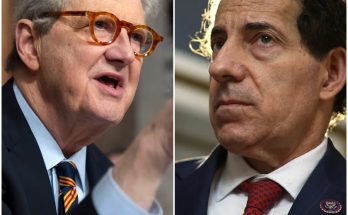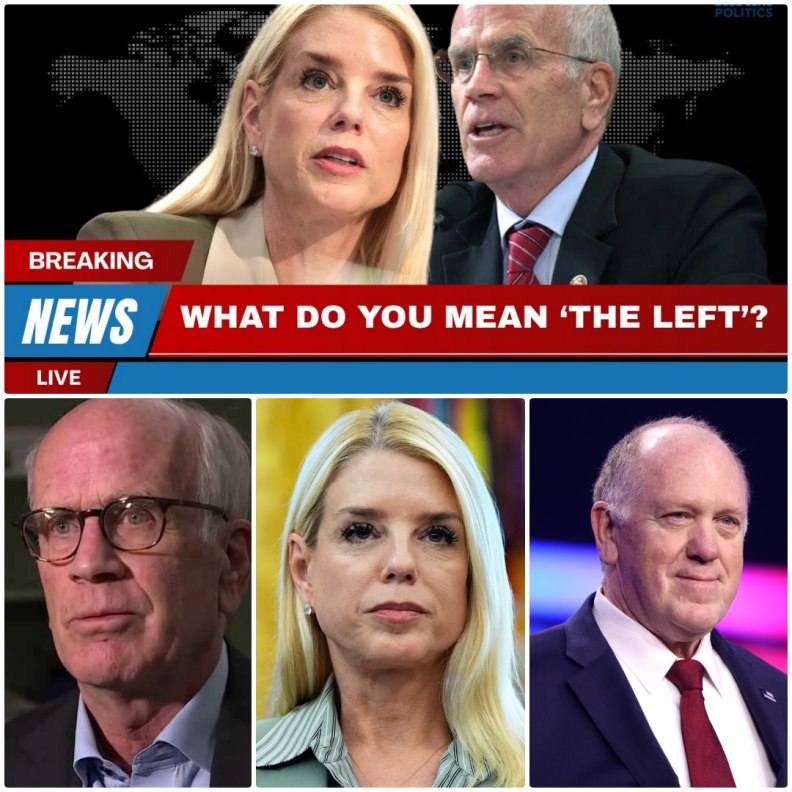
The halls of the United States Senate have long been a stage for the fundamental tensions of American democracy, but rarely does a single question strip away the veneer of political jargon so effectively. This week, during an intense hearing before the Senate Judiciary Committee, Senator Peter Welch of Vermont engaged in a high-stakes exchange with Attorney General Pam Bondi.
It was a confrontation that transcended the typical partisan bickering, evolving instead into a profound “constitutional stress test” for the Department of Justice. At its heart was a question that seemed simple on the surface but carried the weight of the entire American legal tradition: “What do you mean by the left?”
This question was not an invitation for a political debate or a request for a dictionary definition. It was a demand for accountability from the nation’s highest law enforcement officer.
As the Department of Justice (DOJ) moves to demand confidential voter files from various states, citing a “takeover by the left,” the burden of proof rests squarely on the shoulders of the federal government. The exchange between Welch and Bondi highlighted a growing and dangerous gap between ideological rhetoric and the factual evidence required to justify the exercise of “awesome prosecutorial power.”
The session began not with legal technicalities, but with the raw, human consequences of the current government shutdown. Senator Welch, known for his measured and persistent demeanor, brought the committee’s attention to a letter he had received from a Vermont family. The family, consisting of two parents in their mid-fifties and three children, is facing a nightmare scenario.
One of their children is battling acute myeloid leukemia, a condition that requires constant, expensive medical intervention. Under the current political impasse, this family—and thousands like them—received notice that their health insurance premiums could triple by November 1st.
Welch’s intent was clear: to establish a baseline of shared humanity. He sought an assurance that the Attorney General, regardless of her political leanings, would prioritize the survival of working families in both red and blue states. However, the response from the Attorney General set a confrontational tone for the rest of the afternoon.
While expressing a surface-level willingness to connect the family with nonprofits, Bondi quickly pivoted the blame toward the opposition. She asserted that the government shutdown was a direct result of Democrats prioritizing “healthcare for illegal aliens” over American citizens.
 This pivot was the first indication of the ideological lens through which the current Department of Justice appears to be operating. By framing a complex budgetary and policy dispute as a binary conflict between “citizens” and “illegal aliens,” the Attorney General signaled that the Department’s priorities are increasingly viewed through a partisan prism.
For the family in Vermont, the “why” of the shutdown matters far less than the “what”—the imminent threat to their child’s life-saving treatment. Welch’s attempt to find common ground was met with a wall of political messaging, setting the stage for the more explosive legal arguments to follow.

As the hearing moved into the realm of voting rights, the tension in the room became palpable. The Department of Justice recently issued letters to several states, including Vermont, demanding comprehensive access to voting files that contain sensitive and personal information of millions of citizens.
The stated justification for these demands, as articulated by the DOJ’s voting rights chief, was to combat a supposed takeover of the election process by “the left.” This is where Welch focused his inquiry, challenging the very vocabulary being used to authorize federal intervention in state-run elections.
“What do you mean by the left?” Welch asked, his voice calm but firm. He pushed Bondi to provide a factual basis for the claim that Vermont’s election system—overseen by a Republican governor and managed through a long history of bipartisan cooperation—was somehow compromised.
The Attorney General’s inability to provide a specific, legal definition of “the left” or to cite a single piece of evidence regarding a “takeover” in Vermont was a watershed moment. It exposed a strategy where vague political labels are used as a “catch-all” justification for federal overreach.
In the American legal system, the power to investigate and sue is supposed to be triggered by specific, credible evidence of illegal activity. If the government can launch investigations based on broad ideological categories like “the left” or “the right,” then the protections of the Fourth and Fourteenth Amendments are in serious jeopardy.
Welch argued that if “the left” cannot be defined in a court of law, then anyone who disagrees with the current administration can be treated as a suspect. This is the definition of the weaponization of justice—using the machinery of the law to target political opponents rather than to prosecute specific crimes.
Bondi’s defense was built on the assertion that the DOJ has the legal authority to request this information and that her office is committed to “fair and free elections.”
However, Welch pointed out a glaring inconsistency in her application of legal standards. When questioned by Senator Ted Cruz about the sentencing of a defendant who had threatened a Supreme Court Justice, Bondi spoke at great length about the “gruesome details” and the government’s plan to appeal.
Yet, when Welch and his colleagues asked about other investigations, Bondi repeatedly hid behind the “pending litigation” rule to avoid answering.
This selective transparency is a hallmark of an institution that has lost its way. When an Attorney General feels free to discuss the details of one case because it serves a specific political narrative but refuses to provide evidence for another because it might expose a lack of factual grounding, the public’s trust in the law is eroded.
The “pending litigation” excuse, Welch noted, seemed to be a one-way street used to deflect legitimate oversight while allowing the Department to maintain a public relations offensive on issues that favor their agenda.
The confrontation reached its boiling point when the discussion shifted to the mysterious handling of $50,000 in FBI funds. Welch pressed for information regarding a tape—both audio and video—that allegedly captured the transfer of this money to Tom Homan.
The Attorney General’s response was a series of sharp denials and a refusal to acknowledge the ongoing public interest in the matter. “Don’t call me a liar,” she snapped at one point, after Welch suggested she must know more about a case of such high profile.
The exchange over the “missing 50k” was more than just a heated moment; it was a symptom of a larger transparency crisis. When a United States Senator cannot get a straight answer regarding the whereabouts of taxpayer money or the existence of evidence in a federal investigation, the system of checks and balances is failing.
The Attorney General’s defense of Homan—praising his work on the border while refusing to address the specific financial allegations—further illustrated a Department that prioritizes loyalty and political performance over administrative accountability.
Throughout the four-hour hearing, a disturbing picture emerged of a Department of Justice that is increasingly untethered from the traditional requirements of evidence.
By using the “awesome authority” of the office to make demands on states like Vermont—which has a Republican governor and no evidence of election fraud—the DOJ is signaling that it views its role not as a neutral arbiter of the law, but as a political enforcer.
The demand for personal voting files, under the vague umbrella of fighting “the left,” sets a precedent that could allow future administrations of any party to use the DOJ to harass their political rivals.
Senator Welch’s “constitutional stress test” was a necessary intervention. It forced a public conversation about the limits of federal power and the necessity of objective truth in the legal process. If we allow the government to define its enemies through ideological labels rather than criminal acts, we move away from a “government of laws” and toward a “government of men”—and women—where the law is whatever those in power say it is.
The implications of this hearing reach far beyond the committee room. For the family in Vermont waiting for news on their healthcare, for the voters in Florida wondering if their personal data is being analyzed by federal partisans, and for every citizen who believes in the impartial application of justice, the stakes are existential.
The “weaponization of the left” as a legal category is a direct threat to the pluralism that sustains American democracy.
In the final analysis, the clash between Peter Welch and Pam Bondi was a battle for the soul of the American justice system. It was a reminder that the power of the Attorney General is a “sacred trust,” one that must be exercised with humility, transparency, and an unwavering commitment to facts. When that trust is traded for political expediency, the entire structure of our republic begins to lean.
The question “What do you mean by the left?” remains unanswered, and until the Department of Justice can provide a factual, legal basis for its actions, the shadow of doubt will continue to hang over its investigations.
As we move toward a new election cycle, the lessons of this hearing must not be forgotten. The defense of democracy requires more than just high-minded rhetoric about “fairness”; it requires the constant, vigilant oversight of those who hold the power to investigate, to sue, and to imprison.
Senator Welch’s persistent questioning serves as a model for how that oversight should be conducted—by stripping away the labels and demanding the truth.