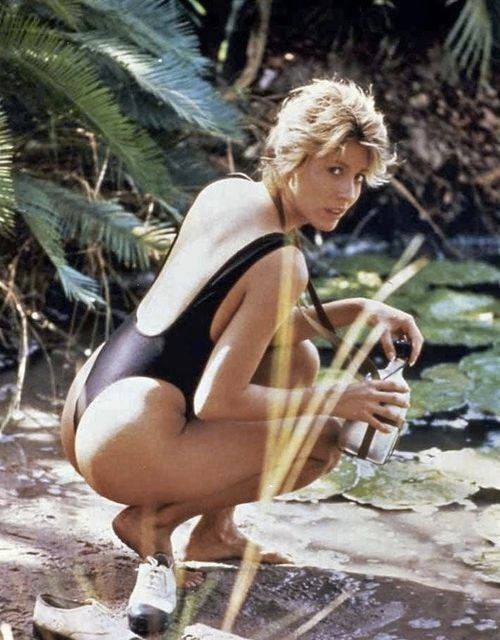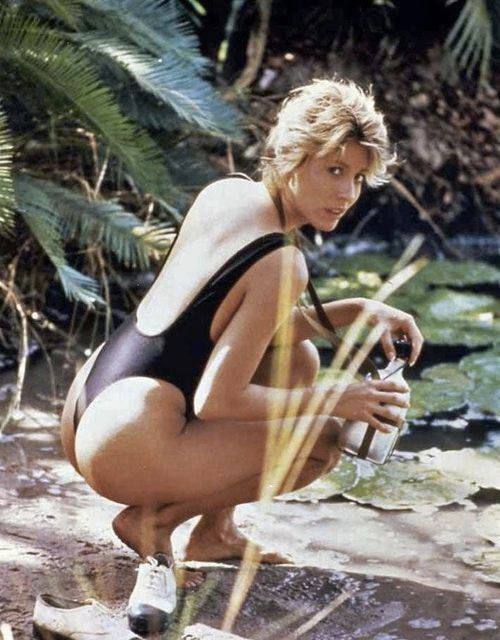
The late twentieth century marked a peculiar turning point in popular culture. It was an era when the most ordinary elements of daily life—fashion choices, offhand remarks, even fleeting cinematic moments—could become cultural landmarks overnight. Among the many icons who emerged from this vibrant period was a character who embodied both elegance and curiosity: Sue Charlton, the polished American journalist who journeyed from Manhattan’s skyscrapers to the untamed wilderness of Australia. Her encounter with the charismatic and unconventional Mick “Crocodile” Dundee became one of the defining cinematic romances of the 1980s. Yet while audiences around the world remember the fictional Sue Charlton with fond nostalgia, far fewer understand the extraordinary real-life journey of the woman who portrayed her—Linda Kozlowski.
Linda Kozlowski’s story is not one of quiet obscurity or unfulfilled promise. Instead, it is a deliberate narrative of reinvention, marked by courage, self-awareness, and the rare ability to walk away from fame at its peak. While many actors chase relevance for decades, Kozlowski chose a different path entirely—one that led her far from Hollywood soundstages and red carpets, into the ancient cities and desert landscapes of Morocco. Her evolution from Juilliard-trained actress to international travel entrepreneur is a testament to the idea that success does not have to follow a single script.
A Foundation Built on Discipline and Craft
Born on January 7, 1958, in Fairfield, Connecticut, Linda Kozlowski grew up far from the glamour she would later encounter. Her early years were shaped by diligence rather than celebrity aspiration. From a young age, she displayed a deep interest in performance, not as a means to fame but as a serious artistic pursuit. Acting, for her, was a discipline—one that required study, restraint, and emotional intelligence.
That commitment carried her to one of the most prestigious institutions in the performing arts world: the Juilliard School in New York City. Acceptance into Juilliard’s rigorous theater program was—and remains—a rare achievement. Graduating in 1981, Kozlowski emerged with a foundation rooted in classical training, stage presence, and character development. Unlike many of her contemporaries who entered Hollywood through modeling or commercial work, she came armed with technique and a profound respect for storytelling.
Her early career reflected this grounding. Rather than immediately transitioning to film, Kozlowski immersed herself in theater, performing in off-Broadway productions that demanded emotional depth and endurance. These roles were not glamorous, nor were they lucrative, but they sharpened her skills and reinforced her belief in acting as a craft rather than a commodity.
A Career Pivot Sparked by Opportunity and Generosity
Kozlowski’s dedication eventually opened doors to larger stages. She earned a role in the Broadway production and subsequent television adaptation of Arthur Miller’s Death of a Salesman. Sharing the screen with Dustin Hoffman—a towering figure in American acting—proved to be a defining moment in her professional life. Hoffman recognized her talent immediately, not merely as a promising newcomer but as a disciplined performer with uncommon potential.
Despite the prestige of the production, financial stability remained elusive. Like many actors navigating New York’s unforgiving theater scene, Kozlowski supplemented her income by waiting tables. The contrast between critical acclaim and economic uncertainty was stark. Hoffman, aware of her situation, extended a gesture that went beyond professional courtesy. He and his wife invited Kozlowski to stay at their Malibu home, offering her both shelter and access to opportunities that would otherwise remain out of reach.
This period in California marked a turning point. With stability came auditions, and with auditions came the unexpected opportunity that would change her life: a recommendation for a low-budget Australian film centered around a bushman navigating modern civilization. At the time, few could have predicted the impact of Crocodile Dundee.
Overnight Fame and an Uncomfortable Box
Released in 1986, Crocodile Dundee exceeded every expectation. Made for a modest budget, the film became a global phenomenon, earning hundreds of millions of dollars and embedding itself in pop culture history. Kozlowski’s portrayal of Sue Charlton struck a chord with audiences. She was intelligent, poised, and adventurous—a refreshing counterbalance to the film’s comedic bravado.
The on-screen chemistry between Kozlowski and Paul Hogan was undeniable, lending authenticity to the story’s emotional core. In Australia, where the film debuted earlier than in the United States, Kozlowski achieved near-instant celebrity status. By the time American audiences caught up, she was already a recognizable face worldwide.
Yet fame brought complications. Despite her training and range, Kozlowski found herself repeatedly offered roles that mirrored Sue Charlton but lacked depth. Hollywood, eager to capitalize on the film’s success, seemed unable—or unwilling—to imagine her beyond the romantic interest archetype. Scripts arriving at her doorstep were formulaic, limiting, and disconnected from the kind of work she had trained for.
For an actress who valued substance over visibility, this was deeply frustrating. She had not spent years mastering her craft to become a decorative presence in someone else’s story. The disconnect between her aspirations and the industry’s expectations grew increasingly difficult to ignore.
Choosing Integrity Over Exposure
Following her appearances in the Crocodile Dundee sequels, Kozlowski made a decision that defied conventional Hollywood logic. Rather than continue accepting roles that failed to challenge or inspire her, she stepped away from acting altogether. It was not a gradual fade-out, nor a consequence of dwindling opportunities. It was a conscious exit.
This decision coincided with significant developments in her personal life. Her on-screen partnership with Paul Hogan evolved into a real-life relationship, and the two married in 1990. As a high-profile couple, they attracted public attention, but they also prioritized privacy. In 1998, they welcomed a son, Chance, and family life became central to Kozlowski’s identity.
For years, she lived largely outside the Hollywood spotlight, content with a quieter existence. However, as time passed, the marriage encountered strain. In 2014, Kozlowski and Hogan divorced, bringing an end to a relationship that had defined much of her adult life.
Reinvention Through Exploration
The conclusion of her marriage marked not an ending, but a beginning. With newfound independence and the financial means to explore life on her own terms, Kozlowski turned to travel—not as an escape, but as a form of rediscovery. She sought places that offered depth, history, and a sense of continuity that Hollywood had never provided.
Her journey eventually led her to Morocco. From her first encounters with its bustling medinas, ancient architecture, and expansive deserts, she felt an immediate connection. Morocco was not simply a destination; it was an experience that engaged all the senses. The rhythm of life, shaped by centuries of tradition, resonated deeply with her.
It was there that she met Moulay Hafid Baba, a Moroccan tour guide whose understanding of the country extended far beyond guidebooks. His insight into the culture, landscapes, and hidden corners of Morocco offered Kozlowski a new lens through which to view the world—and herself.
Their relationship grew organically, rooted in mutual respect and shared curiosity. What began as companionship evolved into both a romantic and professional partnership.
Building a New Legacy
Together, Kozlowski and Baba founded Dream My Destiny, a boutique luxury travel company based in Marrakech. The venture reflected Kozlowski’s unique perspective: travel not as consumption, but as storytelling. Each itinerary was designed to offer meaningful engagement—introducing clients to local communities, traditions, and landscapes often overlooked by conventional tourism.
Kozlowski discovered that her acting background translated seamlessly into this new field. Years of studying characters had honed her ability to read people, anticipate emotional needs, and construct narratives. In designing travel experiences, she applied these same skills, crafting journeys that felt personal, transformative, and authentic.
Unlike Hollywood, where she often felt constrained, the travel industry allowed her to operate creatively and independently. She was no longer confined by casting decisions or studio expectations. Instead, she shaped experiences that aligned with her values.
A Life Defined by Choice
Now in her sixties, Kozlowski lives in Marrakech, surrounded by color, history, and purpose. The woman who once navigated fictional outback landscapes now traverses real deserts, markets, and mountain paths. While her appearance has naturally changed with time, she radiates a confidence that comes from alignment rather than acclaim.
She speaks openly about the contrast between her past and present lives. Where Hollywood demanded constant visibility, Morocco offers presence. Where fame imposed limitations, entrepreneurship provides freedom. Her fulfillment is no longer measured by public recognition, but by the richness of daily experience.
Though she remains fondly remembered for her role as Sue Charlton, Kozlowski views that chapter as only the opening act of a much larger story. Her journey challenges the assumption that success must be linear or permanent. Instead, it illustrates the power of choosing change, even when the world expects continuity.
A Legacy Beyond the Screen
Linda Kozlowski’s career in film may have been brief, but her impact endures. For audiences, she remains an emblem of 1980s cinema—a symbol of curiosity, intelligence, and grace. For herself, however, the greater achievement lies in having stepped away from a life that no longer fit and building one that did.
Her story serves as a reminder that reinvention is not a failure of ambition, but an expression of it. By leaving behind the certainty of fame and embracing the unknown, she authored a life defined not by roles assigned to her, but by choices she made for herself.
In doing so, Linda Kozlowski proved that the most compelling narratives are not always played out on screen. Sometimes, the bravest performance is the decision to walk away—and write an entirely new story.