My Brother Refuses to Sleep in His Bed — He Says the Cow Knows What Really Happened
The farm has never been truly quiet, not in the way people imagine when they think of wide fields and open skies. There are always sounds: wind sliding through tall grass, insects droning in the hedges, animals shifting their weight in the barn. But lately, the silence inside our house has felt unnatural, heavy, almost deliberate, as if something unseen has pressed a finger to its lips and demanded stillness.
My younger brother Leo used to be the loudest thing in our world.
He was energy without pause, a boy who never learned how to be still. He ran everywhere, even when walking would have been easier. He laughed too loudly, talked too fast, and asked questions without waiting for answers. He climbed trees higher than he should have, ignoring our parents’ warnings, and would stand on the highest branches shouting down at us like he had conquered something ancient and important.
That boy disappeared last autumn.
In his place is a child who moves carefully, who speaks only when necessary, and even then in a voice so soft it barely carries across a room. His eyes no longer dart with curiosity; instead, they linger on shadows and corners, as if he expects something to emerge when he isn’t looking directly at it. The change wasn’t gradual. It wasn’t the slow shift of growing up. It happened all at once, like a switch flipped in the dark.
It happened the day we came back from the back acres of the farm.
That was late October, when the leaves had turned brittle and the air smelled like decay and cold earth. We’d gone out farther than usual, past the tree line where our parents normally told us to stay. Leo had begged me to come with him, insisting he wanted to show me something he’d found weeks earlier. I don’t remember much about the walk itself — just that he was unusually quiet the entire way.
When we came home that evening, something in him was wrong.
By nightfall, he refused to sleep in our shared bedroom. At first, we thought it was a tantrum or a sudden fear of the dark. But Leo didn’t cry or argue. He simply said no. He wouldn’t touch his bed. Wouldn’t lie down. Wouldn’t even sit on the mattress.
Instead, he walked straight past the house and into the barn.
That was the beginning of his exile.
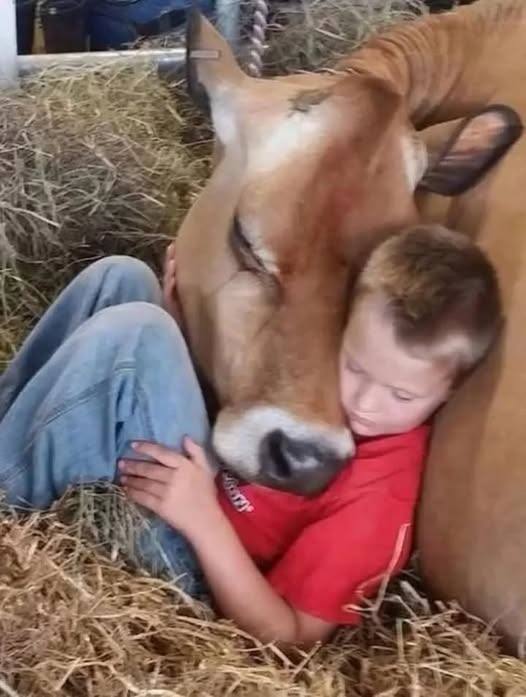
Every night since then, Leo has slept in the hayloft beside Daisy, our oldest Jersey cow. No matter how cold the weather became, no matter how much our parents pleaded, he insisted on staying there. He wraps himself in old blankets and presses his body against her massive, warm side, as if anchoring himself to something solid and alive.
Seeing him there unsettles me more than I want to admit.
Daisy is gentle, slow-moving, and patient in the way only old animals are. She doesn’t flinch when Leo curls into her. She doesn’t protest when he buries his face into her neck. She simply stands or lies there, breathing steadily, eyes half-lidded, as if she understands something the rest of us don’t.
My mother calls it “sweet.” She tells friends that Leo has formed a special bond with one of the animals, that it’s a phase, maybe even healthy. My father barely comments at all. He shrugs and mutters that boys go through strange stages and that winter will chase him back into the house eventually.
But I know better.
Leo isn’t sleeping in the barn because he loves Daisy.
He’s hiding.
A few nights ago, that realization finally pushed me past my fear. Long after the house had gone dark and the floors had stopped creaking with our parents’ footsteps, I slipped outside and crossed the yard toward the barn. The moon was thin and sharp, and the air smelled of frost and hay.
Inside, the barn felt alive in a way the house no longer did. Animals shifted in their stalls. The sound of breathing — slow, rhythmic, enormous — filled the space. I stayed near the wall, careful not to make a sound, and looked up toward the hayloft.
Leo was there.
He was sitting with his forehead pressed against Daisy’s neck, his arms wrapped around her like he was afraid she might vanish if he let go. He didn’t know I was watching.
And then he spoke.
“I didn’t tell them,” he whispered, his voice barely audible over the animals’ breathing. “I didn’t say it was me.”
My heart slammed against my ribs.
“I know you saw,” he continued, his words trembling. “You were there. You know what happened. But you didn’t tell either.”
Daisy blinked slowly, her large eyes dark and unreadable.
“Thank you,” Leo murmured. “Thank you for keeping it.”
I stood frozen, the cold seeping through my shoes, my skin prickling with a fear I couldn’t name. Whatever Leo was carrying, it wasn’t imaginary. It wasn’t childish fear or an overactive imagination.
He was confessing.
The next day, I found him behind the grain silo, sitting on an overturned bucket, staring at the dirt. I didn’t plan what to say. I just knew I couldn’t pretend anymore.
When I asked him why he wouldn’t come back into the house, his composure shattered.
He collapsed forward, grabbing my hand with startling strength, his fingers digging into my skin as if I were the only thing keeping him upright. He sobbed — not loudly, not dramatically, but in short, broken gasps that sounded painful to produce.
“Please,” he said. “Don’t open the red toolbox.”
The words came out tangled and desperate.
“And don’t show them the picture. Don’t let anyone see it. Promise me.”
I didn’t understand what he meant, not fully, but I promised anyway. I promised because his fear was raw and real, and because whatever he was protecting himself from had already taken too much from him.
Still, the phrase red toolbox echoed in my head.
My father owns more tools than I can count. Toolboxes sit in the workshop, the tractor shed, the garage. Some are new. Some are older than I am. It took hours of searching before I found it.
The red toolbox was hidden beneath the tool shed, tucked into a crawlspace under rotting boards and old burlap sacks. The metal was rusted and flaking, the paint peeling away like old scabs.
When I opened it, my hands shook.
On top lay a Polaroid photograph, curled and yellowed with age. The image was grainy, poorly lit. It showed the woods at the far edge of our property, near the old stone well that had been sealed years ago.
A figure stood at the edge of the pit.
I recognized the jacket immediately — Leo’s blue windbreaker.
But it wasn’t the figure that made my stomach drop.
It was what lay on the ground near his feet.
Beneath the photo were other items: a silver cufflink, scratched and unfamiliar. A set of car keys that didn’t belong to any vehicle we owned. And a small leather-bound journal, its pages filled with handwriting I didn’t recognize.
Everything clicked into place with horrifying clarity.
Last fall, a man had gone missing in the state park that bordered our land. A hiker. There were searches. News reports. Eventually, the story faded.
The woods were too big, they said.
I sat on the dirt floor of the shed for a long time, the open toolbox beside me, the weight of what I now knew pressing down until it felt hard to breathe.
Leo hadn’t changed because of fear.
He’d changed because he’d crossed a line no child should ever cross.
He slept beside Daisy because she didn’t ask questions. She didn’t judge. She didn’t demand explanations or confessions. She simply existed, warm and alive, a silent witness who couldn’t betray him.
When I finally closed the toolbox and slid it back into the darkness, I understood that I had become part of the secret.
I was no longer just his sibling.
I was another witness.
Another keeper of silence.
And as I walked back toward the house, I knew that the noise of our childhood — the laughter, the shouting, the freedom — was gone forever. In its place was something quieter, heavier.
A truth that would never be spoken aloud.